When talking about gardening, it doesn’t take long before native plants become part of the conversation. Articles about native plants appear in the media on a regular basis and more gardeners, from novice to experienced, are using plants classified as native. One question comes up repeatedly in these conversations, including from people who are familiar with the movement to plant more natives. It’s a fundamental question with an elusive answer: “What exactly is a native plant?”
Many online and print resources dealing with native plants do not provide a definition. Search the website, skim the webpages, check the index, read the table of contents, and perhaps you’ll find a phrase or two of explanation buried in a paragraph. The assumption seems to be that everyone can recognize a native plant and knows how to distinguish between plants that are native and non-native. Or maybe the complexity is the challenge. As the U.S. Department of Agriculture states, “Native status is difficult to define and is somewhat arbitrary in circumscription.”
In “What is a Native Plant?,” the University of Maryland Extension program cuts through some of the confusion by stating that native plants “1. Occur naturally, 2. In their ecoregion and habitat where, 3. Over the course of evolutionary time, 4. They have adapted to physical conditions and co-evolved with the other species in the system.” Setting aside the criterion of occurring naturally, which one might argue is “arbitrary in circumscription,” this definition introduces two concepts important to consider when gardening with native plants: ecoregions, and adaptation and evolution.
An ecoregion is an area with similar plant communities, climate, geography, hydrology, and geology. The U.S. Environmental Protection Agency has identified ecoregions for North America at different levels of detail. The EPA Level III ecoregion for the Northern Piedmont (Ecoregion 64), stretches from Richmond, Virginia to a bit northwest of New York City. If you live in Ecoregion 64, you should buy plants from nurseries within that ecoregion. The plants are grown in a climate similar to the one in which they’ll be planted, with relevant insect communities, and it is less likely that non-local pests will be transported with the plants and introduced to your garden.
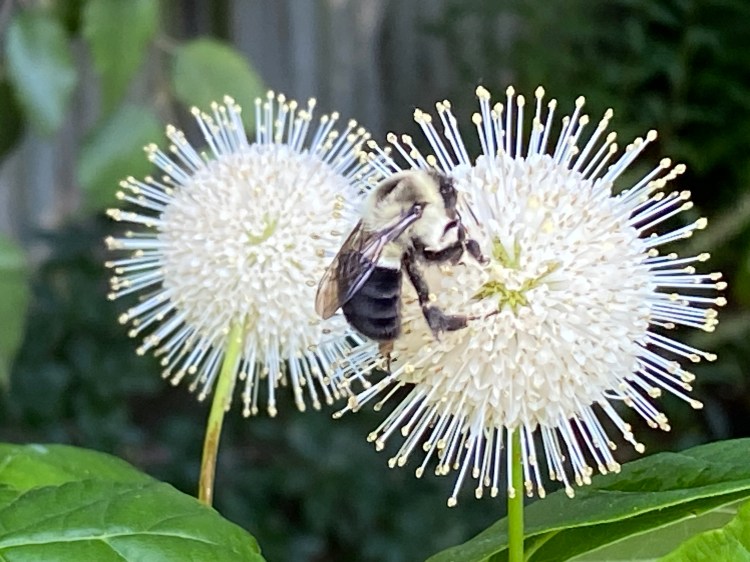
Evolution and adaptation create dependencies between larval insects and the host plants that feed and nurture them and between a plant’s reproductive structures and the specialized insects that can access the plant’s pollen and ensure fertilization and seed and fruit production. Most plants require pollination by insects to ensure the survival of future generations and to continue the genetic diversification that allows adaptation to changing conditions. Animals consume plants directly or by feeding on other animals that eat plants, and they rely on plants for shelter and habitat. Insects feed on and pollinate plants but also serve as a food source at different stages of development, with larval forms such as caterpillars supplying certain songbird nestlings with the bulk of their diet. These interrelationships form an argument for designing gardens to support insects, by increasing the use of insect-attracting native plants.
But not any native plant from your ecoregion will do. According to some horticulturalists, the plants must be the straight species found in nature, not a cultivated variety, or cultivar, such as white echinacea or blue-leaved fothergilla. The concern is that planting native cultivars, also known as nativars, promotes genetic mixing of wild and cultivated forms of a species, with the cultivated forms eventually replacing the wild. Nativars have not developed in association with pollinators and may not be as beneficial as the straight species. To prevent genetic domination by nativars, horticulturalists may recommend planting non-native species, as long as the non-natives are not invasive.
These requirements present the gardener with challenges. If Coreopsis verticillata ‘Zagreb’ is perfect for your garden design and can be obtained from a vendor within your ecoregion, do you plant it and ignore concerns that it is a nativar and not the straight species? Or do you find another perspective to follow? According to the Mt. Cuba Center research report on coreopsis, cultivars of coreopsis provide nectar and pollen for a wide variety of insects, and ‘Zagreb’ does so for bumble bees, honey bees, the dark sweat bee, green sweat bees, and hover flies. Do these benefits outweigh the potential impact of planting a native cultivar? How does a gardener decide what to do?
Considering these issues can be a headache, and it places gardeners in the position of becoming amateur horticulturalists when they may not have the time or desire for this level of involvement. If we want more gardens, or most gardens, to be ecological gardens, we need native plant selection and acquisition to be easier processes. Many resources are available online and in print to assist (see the Xerces Pollinator-Friendly Native Plant Lists as one good example), but gardeners would benefit if more of this information was provided at the point of sale, online and at garden centers. Labeling plants as host plants, nectar plants, and pollen plants and listing the names of at least a few of the insects that depend on these plants clarifies a plant’s value, much more so than the generic term “native.” If a plant produces seeds or fruits consumed by birds, it’s useful to name the bird species the plant attracts. Adding the ecoregion to the plant label confirms the plant is appropriate for a specific location. Identifying non-native plants that provide pollinator benefits, such as pollen and nectar, with no negative environmental effects, simplifies one of the more difficult decisions of ecological gardening: is it okay to put this non-native plant in my garden?
Addressing several of these concerns is the Pollinator-Friendly Plant Labeling Act, which was introduced in the U.S. Senate on June 22, 2023. The program promoted by the Act will certify and label plants as “USDA pollinator-friendly” when certain criteria are met, including official designation as a native plant by the Chief of the USDA Natural Resources Conservation Service and production without pesticides harmful to pollinators. Certified plants will be labeled with “the county or ecoregion that the plant species is native to and locally adapted to,” the scientific and common names of the plant, and the name of the plant producer.
If the Act is signed into law, a lot of decision-making will become less complicated for experienced and aspiring gardeners. Time invested in understanding the nuances of native plant selection can be redirected to getting more plants in the ground, and perhaps to advocating for even more comprehensive labeling. The Act turns the focus away from debates about the definition of native plants and brings it back to where it should be — on helping everyone create pollinator-friendly ecological gardens that benefit the environment. And that’s a good thing.
Notes
- PLANTS Database Help Documentation. Native Status Jurisdiction and Native Status Codes. U.S. Department of Agriculture. Natural Resources Conservation Service. Accessed September 4, 2023. https://plants.usda.gov/assets/docs/PLANTS_Help_Document_2022.pdf
- Tangren, Dr. Sara. “What is a Native Plant?” University of Maryland Extension. Updated February 15, 2023. Accessed September 4, 2023. https://extension.umd.edu/resource/what-native-plant
- Level III and IV Ecoregions of the Continental United States. U.S. Environmental Protection Agency. Last updated on July 5, 2023. Accessed September 4, 2023. https://www.epa.gov/eco-research/level-iii-and-iv-ecoregions-continental-united-states
- Coombs, George. “Coreopsis: For the Mid-Atlantic Region.” Mt. Cuba Center Research Report. December 2015. Accessed September 4, 2023. https://mtcubacenter.org/trials/coreopsis/
- Pollinator-Friendly Native Plant Lists. Xerces Society for Invertebrate Conservation. Pollinator Conservation Program. Accessed September 4, 2023. https://xerces.org/pollinator-conservation/pollinator-friendly-plant-lists
- Congress.gov. “S.2199 – 118th Congress (2023-2024): Pollinator-Friendly Plant Labeling Act.” June 22, 2023. Accessed September 4, 2023. https://www.congress.gov/bill/118th-congress/senate-bill/2199
If you’d like to learn more . . .
“Cultivar, Nativar, Variety.” Illustrated Glossary. Master Gardeners of Northern Virginia. Accessed September 5, 2023. https://mgnv.org/plants/glossary/cultivar-nativar-variety/
Keystone Plants by Ecoregion. The National Wildlife Federation. Accessed September 5, 2023. https://www.nwf.org/Garden-for-Wildlife/About/Native-Plants/keystone-plants-by-ecoregion
Nativars: Where do they fit in? Wild Ones. Accessed September 4, 2023. https://wildones.org/resources/nativars/
Native Gardening. U.S. Forest Service. Accessed September 5, 2023. https://www.fs.usda.gov/wildflowers/Native_Plant_Materials/Native_Gardening/index.shtml
New Legislation Would Establish USDA Label for Pollinator-Safe Plants. Xerces Society for Invertebrate Conservation. Accessed September 5, 2023. https://xerces.org/press/new-legislation-would-establish-usda-label-for-pollinator-safe-plants
Tangren, Dr. Sara. “Cultivars of Native Plants.” University of Maryland Extension. May 2019. Accessed September 5, 2023. https://extension.umd.edu/resource/cultivars-native-plants
Thieblot, Bernice. “What is a Native Plant?” The Garden Shed Newsletter. February 2023-Vol.9, No.2. Piedmont Master Gardeners. Accessed September 5, 2023. https://piedmontmastergardeners.org/article/what-is-a-native-plant/
White, Annie. “From Nursery to Nature: Evaluating Native Herbaceous Flowering Plants Versus Native Cultivars for Pollinator Habitat Restoration” (2016). Graduate College Dissertations and Theses. 626. Accessed September 4, 2023. https://scholarworks.uvm.edu/graddis/626
 Edgings Garden Research and Design