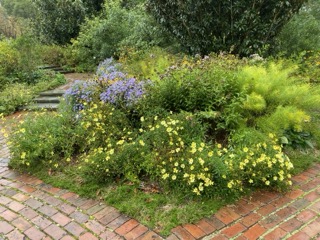
I don’t recall the first time I heard of Mt. Cuba Center, but for the last few years this native plant garden in the Brandywine Valley area of Delaware has been on my bucket list of Mid-Atlantic gardens to visit. In October, I was fortunate to spend part of a day roaming the site, soaking up its inspiration for native plant design.
Driving west from the village of Montchanin, the road to Mt. Cuba rises and falls with the terrain, winding past centuries-old and contemporary dwellings built of stone, property boundaries marked by well-maintained stone walls, and intimate stretches of road-hugging woods. The entrance to Mt. Cuba appears without much fanfare, a driveway that disappears up a hill and through the trees.
Along that drive are fences and walls, planted with trumpet honeysuckle vines intermittently spaced, and beyond that a beautiful rural scene. When the parking lot appears, it’s a tease for what’s to follow. With neat groupings of perennials between each row of vehicles, it feels soft and pretty. If this is the parking lot, I think, I can’t wait to see the South Garden, the formally planted native garden that I’m most interested in visiting.
The idea of creating a formal garden using native plants makes good design sense. It’s an approach that controls the wildness of native perennials and shrubs, which can overwhelm the senses when planted in dense communities. This control makes the garden more comprehensible, with recognizable parts combined to create an integrated whole. It’s not an attempt to replicate nature but to selectively highlight how amazing native plants can be, through the presentation of an organized space. Organization may be vertical (the varying heights of perennials, shrubs, and trees), horizontal (foreground, middle ground, and background), or by pattern (clusters or flowing sweeps of the same plant, with colors and textures grouped to lessen visual busyness). The number of species planted is limited and plenty of open space is available throughout the garden for viewing the composition.
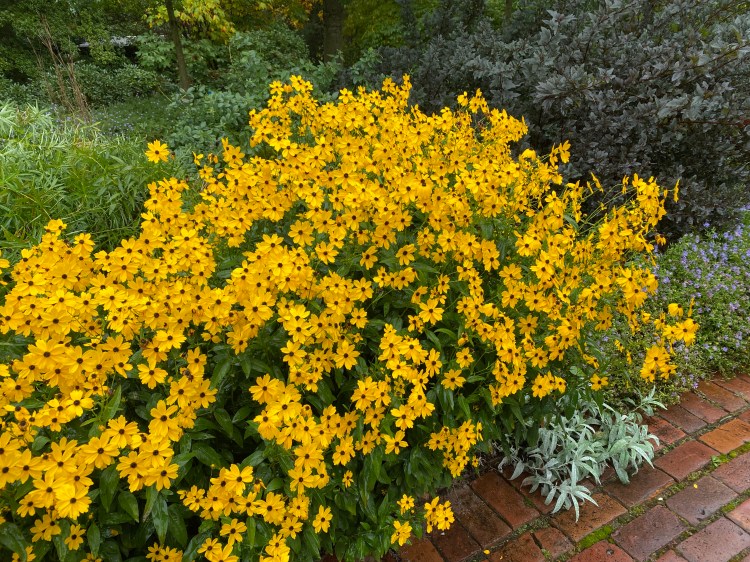
Mt. Cuba Center South Garden
In Mt. Cuba’s South Garden in autumn, amsonia forms a feathery golden backbone, carrying across the different beds at a middle distance or in the background. Lavender asters spill onto the walkways, multi-stemmed ninebark punctuates the flow of perennials with wine-colored foliage, penstemon flower stems have been cut back to reveal the green and maroon basal foliage hugging the ground, and thigh-high Coreopsis palustris ‘Summer Sunshine’, almost shrub-like, startles with its flush of yellow flowers. What season is it again, I wonder, every time I come upon their vivid display around the garden.
The South Garden is a showcase for native cultivars, the cultivated varieties of straight species growing wild. Cultivars often appear tamer, with shorter heights and less legginess, a greater abundance of flowers, and leaf colors not commonly found in nature. Setting aside the debate about whether cultivars should be used in a native plant garden, from a design perspective, they can be stunning. They’re developed for the garden, and at Mt. Cuba they’re combined with a few straight species in beds bordered by winding brick walkways and areas of turf. The walkways provide a closeup of the planting arrangements and individual plants, while the expanses of turf allow a view of the sections that join to make up the South Garden.
Mt. Cuba Center
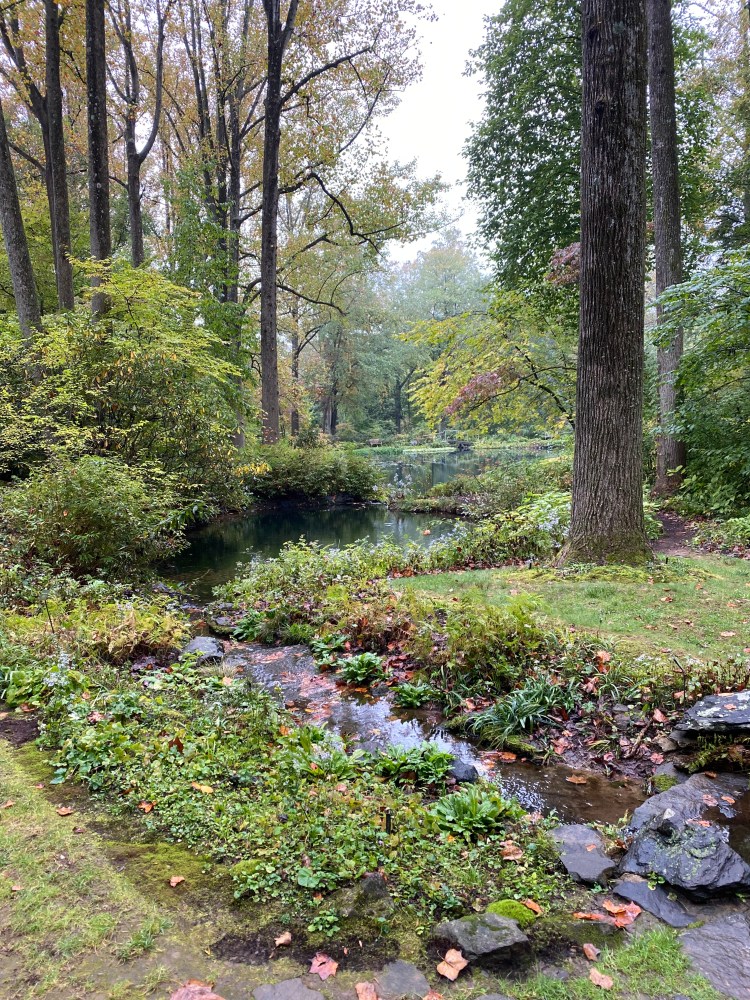
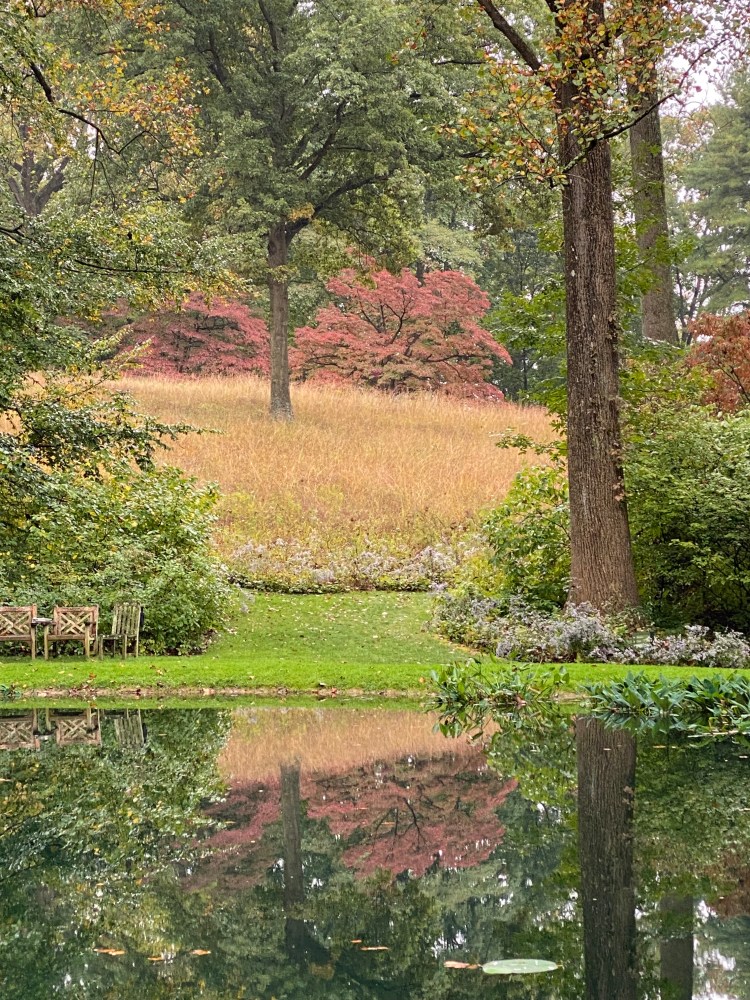
Near the South Garden is the Trial Garden, where native plants, including many cultivars, are assessed for hardiness and benefits to pollinators, such as production of nectar and pollen. Located beyond are the wilder but still designed Naturalistic Gardens. Straight species of native plants, including trees and shrubs, dominate in these gardens, and the visual impression is of a tranquil park and stretch of woods, especially on a day of drizzle with few fellow visitors. The entire area is one of carefully designed views, of a stream, pond, and fields in the distance, but so well composed they appear natural.
Mt. Cuba’s colors and textures and landscapes seep in, even when visiting for just a few hours. The South Garden in particular feels comprehensibly beautiful. By being visually understandable, it succeeds in promoting the use of native plants, showing what’s possible with native plant design and how that design might be emulated in the home garden.
Mt. Cuba Center
If you’d like to learn more . . .
Mt. Cuba Center. Accessed December 23, 2023. https://mtcubacenter.org/
Mt. Cuba Center. Gardens Map. Accessed December 23, 2023. https://issuu.com/mtcuba/docs/21028-garden_and_trail_maps__may_-final
Mt. Cuba Center. Mt. Cuba’s Featured Plants. Accessed December 30, 2023. https://mtcubacenter.org/gardening-resources/featured-plants/
Mt. Cuba Center. South Garden Plant List. Accessed December 30, 2023. https://mtcubacenter.org/southgarden
Mt. Cuba Center. Trial Garden. Accessed December 23, 2023. https://mtcubacenter.org/research/trial-garden/
 Edgings Garden Research and Design