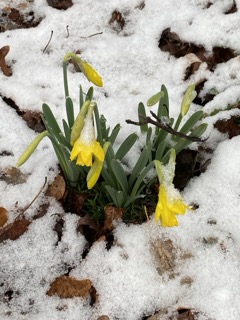
On March 6, I wrote, “The miniature irises in my garden, early spring-blooming bulbs, have already flowered and faded. The daffodils are in their prime, cheerily, ecstatically yellow. Blossom watches for the cherry trees around the Tidal Basin report the buds are close to opening, at least two weeks early. And yet Orion, the classic constellation of winter in this region, continues to appear in the night sky.”
Then, on March 18, “the only remnants of the irises are spindly spikes of foliage, most of the earliest blooming daffodils have crumpled, and the cherry trees at the Tidal Basin are at their peak, two weeks ahead of the average peak date as anticipated.”
And, “in my garden a second wave of daffodils is preparing to bloom, the serviceberry is about to join them, lilac leaves (leaves!) are emerging, and green mounds of new perennial foliage are pushing up everywhere amidst the covering of fall leaves: fire pinks and sun drops, alliums and salvia, asters and echinacea and penstemon.”
When all this activity began, I could only think of phenology–the study of when plants bloom and leaf out–and how phenological cycles have been affected by climate change. The USA National Phenology Network has data indicating how early or late spring occurs each year, and a Washington Post article published in March used this data to show that spring in the D.C. area began about 13 days earlier this year than in 1981. This readjustment of the timing of spring is not good. Plants, in addition to their aesthetic qualities, are interconnected with the lifecycles of insects. Flower too early or late, and the insects dependent on them for pollen and nectar are out of luck, while the plants’ needs for the pollination that creates each generation may go unmet.
If I were to sit down now with Louis Halle’s Spring in Washington (published in 1947) or Edwin Way Teale’s North With the Spring (published in 1951), how would their descriptions of the season compare with what I am seeing in 2024? I have a dusty (and accurate, I hope) memory of reading Tom Horton’s 1987 ode to the Chesapeake, Bay Country, in which he describes the herring run in Rock Creek Park occurring around the time the violets were blooming. Thirty-five years ago, the violets in my yard bloomed near the end of March. This year I found violets, mostly scattered around the lawn, opening about the same time as the miniature irises, and I wondered if the herring have survived.
I can’t deny the beauty when spring bursts forth in concentrated form. It’s a kind of horticultural rush, and there’s a desire for more. When will the baptisia emerge and bloom? Why haven’t I seen the turtleheads yet? Then I notice the amsonia, with buds opening while the stems are only about 18 inches high rather than the 30 inches I remember from the past. What’s going on here, and is this anomaly another response to a warming climate?
The garden continues to unfold. There’s no stopping it now, and I cannot slow it down. But I can do more than become entranced by the beauty of this condensed spring and immobilized by what it means. I can keep planting. And I can vote.
Notes
- USA National Phenology Network. Accessed May 8, 2024. https://www.usanpn.org/
- Stevens, Harry. “Spring is getting earlier. Find out how it’s changed in your town.” Washington Post. March 13, 2024. Accessed May 8, 2024. https://www.washingtonpost.com/climate-environment/interactive/2024/spring-earlier-arrival-plants-map/
- Halle, Louis Joseph. Spring in Washington. New York: William Sloane Associates, 1947.
- Teale, Edwin Way. North With The Spring: A Naturalist’s Record of a 17,000 Mile Journey with the North-American Spring. New York: Dodd, Mead, 1951.
- Horton, Tom. Bay Country. Baltimore: Johns Hopkins University Press, 1987.
 Edgings Garden Research and Design