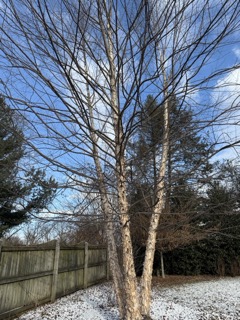
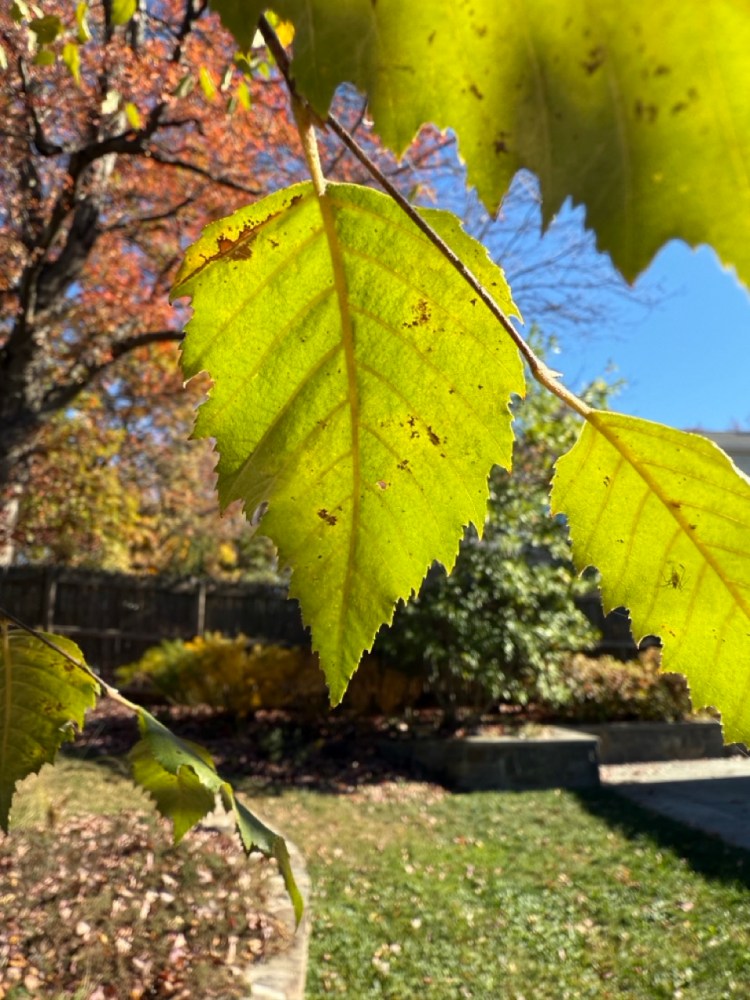
The sky begins to lighten in shades of rose and pink, and a golden-crowned kinglet is a few thousand feet above ground, looking down on the Maryland suburbs of Washington, D.C. Brick, concrete, and pavement are everywhere: high-rise buildings, roadways, parking lots, and roofs but also lawns, shrubs, and then the crowns of trees, lots of trees. The kinglet descends into a neighborhood, and moving from yard to yard, finds among the vegetation a familiar shape. A river birch, its three trunks gracefully angled outward, the bark shaggy, the leaves jagged-edged and widely spaced, rises above the shrubbery. The kinglet stops to investigate, because it knows this tree is likely to hide among the crevices of its bark the spiders, mites, and other small arthropods it prefers to eat.
Every spring and fall, often in late March or early April and toward the end of October, a kinglet or two (or maybe more that I don’t see) will stop by this tree, in my suburban garden. For a few minutes, with movements so quick it could be mistaken for falling leaves, it drops from a top branch to the next and the next, on down, searching for insects. Reversing its path, it moves upward, and then again down, flicks sideways, dangles, follows a branch to its tip, and continues the acrobatics.
Why so frenetic? Because it’s in a race to replenish the calories it’s constantly losing, through daily life and migration, southward in the fall from as far north as the spruce and pine forests of Canada, and northward in the spring from as far south as Florida and northeastern Mexico.
Life as a golden-crowned kinglet used to begin primarily in the boreal forest of the United States and Canada, but the breeding range has been extending southward, as close as the Appalachian Mountains of western Maryland, western Virginia, and southeastern West Virginia. It’s a shorter-distance migrant, but flying a thousand miles twice a year, or even hundreds of miles, when you weigh about the same as two or three pennies seems worthy of recognition. And when a kinglet stops by the birch in my yard–when I’m lucky enough to spot it among the branches–I think about all it has seen and will see and how amazing it is that it survives.
Golden-crowned kinglets are not an endangered or threatened species, at least in the eastern U.S., but that may be because of the increasing number of spruce trees being planted, which have helped expand its breeding range. A few spruce and hemlock dot the neighboring yards, but the birch, a genus of trees familiar from the kinglet’s breeding grounds, is not common in the neighborhood. I wonder, would kinglets stop by my garden if it had not been planted? It is a river birch cultivar, Betula nigra ‘Heritage’. Selected for its ability to withstand the heat and drought of Maryland summers, it has adapted well to its site and has grown 18 feet in five years. As a cultivar, it most likely is not a host for as many moths and butterflies as straight species of river birch, but its chances for survival in this climate are greater. It has done what I had hoped, which is to supply food–caterpillars, flower buds, seeds–to resident and migrating birds, kinglets among them.
During spring and early summer, the birch receives visits from hungry house finches, goldfinches, and the occasional downy woodpecker, and song sparrows in particular seem to enjoy perching high in the branches to sing. It plays a significant role in supporting wildlife, and it is lovely in the garden.
That any creatures find what I have planted for them–trumpet honeysuckle and cardinal flower for ruby-throated hummingbirds, butterfly weed for monarch butterflies, heath aster and agastache for bees–continues to astonish. That golden-crowned kinglets passing through repeatedly find the birch is an argument for planting even more intentionally for wildlife. It feels a bit like a lure for my benefit, but it not only supplies wonder–it assists in kinglet survival.
Consider a night in October as an example, a night close to when I spotted the kinglet. On October 19, 2024 an estimated 328,700 birds flew over Montgomery County, Maryland according to The Cornell Lab’s BirdCast. At the time of greatest activity, an estimated 66,500 birds were in flight, winging across at an average of 17 miles per hour south to southwest and at an altitude of 4,500 feet. Among the likely species in flight, based on observations reported through eBird, were golden-crowned kinglets. Was the kinglet that stopped by my birch to refill its reserves among that crowd? As with monarch butterflies, if kinglet habitat disappears, or the habitat of other songbirds that flew across the county that night, and there no longer are stopover sites for refueling, what will happen to their populations?
So much occurs in nature that we do not see or sense. All that movement in the night skies, and we are often unaware. Migrating birds pass through, but we may not stop to think about where they came from or where they’re headed or even that they’re on a journey. How nature functions may feel overwhelming and unknowable, and it may seem there’s no way we can contribute to keeping it going. But we do have options, and one is to plant for wildlife, including birds.
Birds need food, the food that emerges from the ecosystems of native birches and oaks, willows and maples, and from elderberries, serviceberries, viburnums, and winterberries. They need food when they’re year-round residents and food when they’re migrating. And when you plant the food-supplying trees and shrubs birds need, the birds will stop. Patience is required, as it may take several growing seasons for a plant to mature enough to produce berries or serve as a host for butterfly and moth larvae. But that patience delivers the reward of watching as the birds–through their eyesight, auditory and other cues, and exploratory behavior–discover the habitat you’ve created. It may be a kinglet in a birch, a robin in a holly, a blue jay in a sweetbay magnolia, or a chickadee in an oak, but they will find what you plant. And often they will remember and return.
Notes
- Cornell Lab of Ornithology. 2025. All About Birds. “Golden-crowned Kinglet.” Cornell Lab of Ornithology, Ithaca, New York. Accessed January 31, 2025. https://www.allaboutbirds.org/guide/gockin
- Cornell Lab of Ornithology. 2025. BirdCast. “Migration Dashboard.” Cornell Lab of Ornithology, Ithaca, New York. Accessed January 31, 2025. https://dashboard.birdcast.info/region/US-MD-031?night=2024-10-19
- Cornell Lab of Ornithology. 2025. eBird. “Golden-crowned Kinglet: Regulus satrapa.” Cornell Lab of Ornithology, Ithaca, New York. Accessed January 31, 2025. https://ebird.org/species/gockin
- Sibley, David Allen. What It’s Like to Be a Bird. “Kinglets,” p. 124-125. New York: Alfred A. Knopf, 2020.
- Swanson, D. L., J. L. Ingold, and R. Galati (2020). Golden-crowned Kinglet (Regulus satrapa), version 1.0. In Birds of the World (A. F. Poole, Editor). Cornell Lab of Ornithology, Ithaca, NY, USA. Accessed December 3, 2024. https://doi.org/10.2173/bow.gockin.01
- Tallamy, Douglas W. Bringing Nature Home: How You Can Sustain Wildlife with Native Plants. Portland, Oregon: Timber Press, 2009.
 Edgings Garden Research and Design