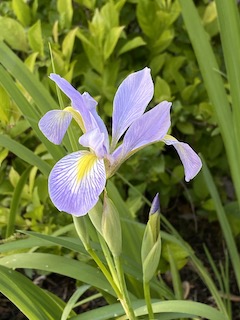
Continue reading “A Few Rules of Thumb for Planning and Planting a Garden”
The Healing Power of Green Spaces

Green spaces—gardens, parks, nature trails, urban forests—are a lifeline at any time but especially, as many of us have discovered, during a pandemic. If these spaces are part of everyday life, it can be as easy to take them for granted as it is to appreciate their value. You grow up with them and expect them to be there, visual backgrounds that may become routine, and as you benefit from them you may not consider their impact until a crisis forces reflection.
That impact is significant and is the focus of an expanding area of research. “How Immersion in Nature Benefits Your Health,”1 “Spending at least 120 minutes a week in nature is associated with good health and wellbeing,”2 and similar articles explore the positive health aspects of nature and gardens and landscapes.
For the gardener or landscape designer, the research findings might seem obvious, because they’re experienced with every minute spent working around plants. But for many, green spaces aren’t easy to access, they’re not part of one’s daily world, and the health benefits don’t exist. The Green Heart project3, mentioned in a previous post, is one study addressing this inequity by assessing the health benefits of planting trees in South Louisville, Kentucky, an area with limited green space and severe air pollution. The results may influence future green space design, including support for expanding access to green space to improve public health.
Gardeners and landscape designers have an opportunity to contribute to this effort now. Every garden adds square footage to a locality’s green space and every garden, whether wild or bird-friendly or traditional, educates neighbors and passersby on the power and beauty and impact of plants. Plot by plot, we can help build support for universal access to green space.
Notes
1. Robbins, Jim. “Ecopsychology: How Immersion in Nature Benefits Your Health.” Yale Environment 360. January 9, 2020. (Published at the Yale School of Forestry & Environmental Studies). Accessed June 20, 2020. https://e360.yale.edu/features/ecopsychology-how-immersion-in-nature-benefits-your-health
2. White, M.P., Alcock, I., Grellier, J. et al. Spending at least 120 minutes a week in nature is associated with good health and wellbeing. Sci Rep 9, 7730 (2019). Accessed June 20, 2020. https://doi.org/10.1038/s41598-019-44097-3
3. Edgecomb, Misty. “Journey to the Coronary Valley: Louisville’s Green Heart Project Tests Nature’s Role as a Prescription for Urban Health.” Perspectives. The Nature Conservancy. October 06, 2017. Accessed June 20, 2020. https://www.nature.org/en-us/what-we-do/our-insights/perspectives/journey-to-the-coronary-valley-louisvilles-green-heart-project/?src=r.v_greenheart
If you’d like to read more . . .
Brindley, Paul et al. “Domestic gardens and self-reported health: a national population study.” Int J Health Geogr (2018) 17:31. Accessed June 21, 2020. https://doi.org/10.1186/s12942-018-0148-6
Carrus G, Scopelliti M, Panno A, Lafortezza R, Colangelo G, Pirchio S, Ferrini F, Salbitano F, Agrimi M, Portoghesi L, Semenzato P and Sanesi G. (2017) “A Different Way to Stay in Touch with ‘Urban Nature’: The Perceived Restorative Qualities of Botanical Gardens.” Front. Psychol. 8:914. Accessed June 21, 2020. https://doi.org/10.3389/fpsyg.2017.00914
Frumkin, Howard et al. “Nature Contact and Human Health: A Research Agenda.” Environmental health perspectives. vol. 125,7 075001. 31 Jul. 2017. Accessed June 21, 2020. https://doi.org/10.1289/EHP1663
Green, Jared. “Green Heart: First Major Clinical Study to Examine the Health Impact of Trees.” The Dirt. 12/18/2017. Accessed June 20, 2020. https://dirt.asla.org/2017/12/18/in-louisville-first-major-clinical-study-will-examine-the-health-impact-of-trees/
Thompson, Richard. “Gardening for health: a regular dose of gardening.” Clinical medicine (London, England). vol. 18,3 (2018): 201-205. Accessed June 21, 2020. https://doi.org/10.7861/clinmedicine.18-3-201
“Tree Equity in America’s Cities – American Forests.” American Forests. Accessed July 18, 2020. https://www.americanforests.org/our-work/urban-forestry/
Note: The original draft of this post was written on June 20, 2020.
Planning a Garden? First Choose the Trees
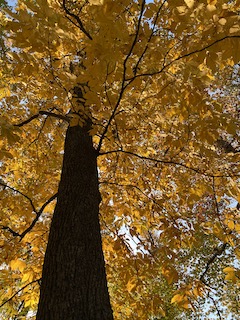
Trees are a natural choice for creating the framework of a garden, marking the perimeter, serving as focal points or a kind of sculptural art, and providing shade and privacy for intimate areas within the larger space. The hardscape of a garden plays a similar role, outlining boundaries and creating interior lines with pathways and patios, walls and fences. But as living structures, trees add elements of change and surprise. If properly sited, they flourish as they pass through the seasons and influence the selection and health of surrounding shrubs and perennials. Continue reading “Planning a Garden? First Choose the Trees”
Native Shade: The Willow Oak
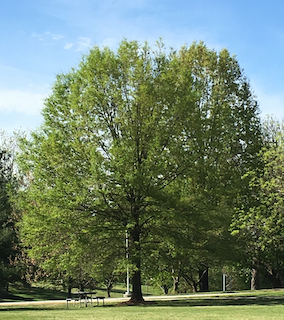
A Willow Oak (Quercus phellos) blends the solid structure of the red oak family — think of the Northern Red Oak or the lesser known but similarly impressive Shumard Oak1 — with the fine-textured appearance of a willow tree’s leaves. Given room to grow in full sun, it is magnificent.
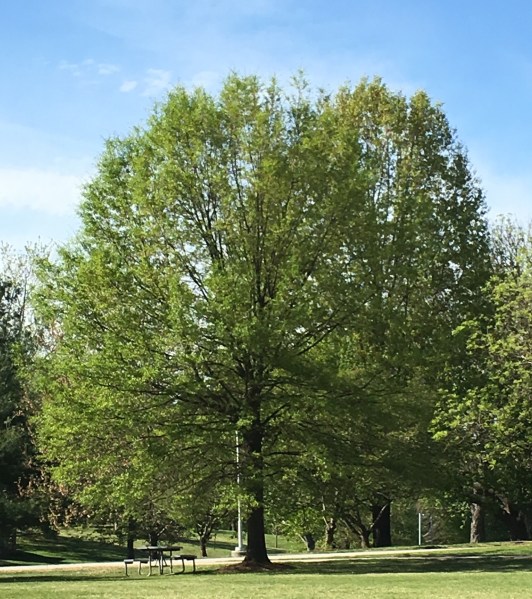
In its early years, the Willow Oak has a pyramidal shape, with a straight, slender trunk and leaves massed on thin branches. Over time this youthful form expands outward and upward as the crown rounds into a globe. The simple, lance-like leaves create an airy feel above a trunk that becomes stout with age.
Native from New Jersey to Texas2, the Willow Oak has a hardiness range of Zones 5 to 9, although the northern part of that range may be pushing its tolerance for cold3,4. Preferring moist soil and sun when growing in the wild, the Willow Oak adapts to a variety of challenging conditions such as drought and clay soil, making it an option for less than ideal environments.
Willow Oaks are large trees, filling out to 75′ or more in height and 50′ across. With the lower branches removed, or limbed up, they work well along roadways and in picnic areas and parks, stretching overhead and providing shade.
And what incredible shade, a broad, cool reach patterned with sunlight.
The leaves that create this dappled expanse emerge, as with many oaks, later in the season than the foliage of most other deciduous trees. Thin, bronze, and bamboo-like from a distance, the leaves slowly lengthen and widen, mimicking the willow’s leaf shape as they deepen from light to dark green. Fall brings shades of yellow before leaf drop and bare limbs unusual for most oaks in winter5.
Oaks provide habitat and nourishment for the caterpillars many bird species rely on for food6, and for the Willow Oak this includes larvae of the Banded Hairstreak, Gray Hairstreak, and Juvenal’s Duskywing7. The plentiful supply of acorns produced every other year feeds foxes, jays, woodpeckers, and deer.
Once you’re familiar with Willow Oaks, you’ll start seeing these elegant, native shade trees everywhere, especially in the Southeast and Mid-Atlantic. It’s not difficult to understand why.

Leaves, catkins, structure of mature Willow Oak

Emerging leaves of young Willow Oak

Leaves of young Willow Oak continuing to emerge
Notes
1. Jensen, Richard J. “5a. Quercus Sect. Lobatae G. Don in J. C. Loudon, Hort. Brit. 385. 1830.” Flora of North America, Vol 3. Fagaceae. Accessed July 20, 2019. http://www.efloras.org/florataxon.aspx?flora_id=1&taxon_id=302020
2. “Quercus phellos.” Native Plants of North America Plant Database. The University of Texas at Austin Lady Bird Johnson Wildflower Center. Accessed July 14, 2019. https://www.wildflower.org/plants/result.php?id_plant=QUPH
3. “Quercus phellos.” Plant Finder, Missouri Botanical Garden. Accessed July 14, 2019. http://www.missouribotanicalgarden.org/PlantFinder/PlantFinderDetails.aspx?taxonid=280755&isprofile=1&basic=quercus%20phellos
4. Dove, Tony and Ginger Woolridge. Essential Native Trees and Shrubs for the Eastern United States. 2018. Watertown, Massachusetts: Charlesbridge. p. 153-155.
5. Finley, Jim. “Winter Leaves that Hang On.” News. PennState College of Agricultural Sciences, Department of Ecosystem Science and Management, Center for Private Forests. Posted: December 17, 2012. Accessed July 14, 2019. https://ecosystems.psu.edu/research/centers/private-forests/news/2012/winter-leaves-that-hang-on
6. Tallamy, Douglas W. Bringing Nature Home: How You Can Sustain Wildlife with Native Plants. Updated and expanded paperback edition, 2009. Portland, Oregon: Timber Press. p. 148-153.
7. “Quercus phellos.” North Carolina Extension Gardener Plant Toolbox. N.C. Cooperative Extension. Accessed July 20, 2019. https://plants.ces.ncsu.edu/plants/quercus-phellos/
If you’d like to read more:
Dirr, Michael A. and Keith S. Warren. “Quercus phellos – willow oak.” The Tree Book. 2019. Portland, Oregon: Timber Press. p. 756-759.
“Host Plants for Butterfly and Moth Caterpillars: Eastern Temperate Forests Ecoregion.” Native Plant Finder. National Wildlife Federation, U.S. Forest Service, University of Delaware. Accessed July 20, 2019. https://www.nwf.org/-/media/Documents/PDFs/Garden-for-Wildlife/Eco-Regions/Eastern-Temperate-Forests_Plant-List.ashx?la=en&hash=616D5224A08F6939620441CFECE9BA90B9496712
Ober, Holly K. “The Value of Oaks to Wildlife.” Department of Wildlife Ecology and Conservation, UF/IFAS Extension. Original publication date August 2008. Revised April 2014. Reviewed June 2017. Publication #WEC248. Accessed July 20, 2019. https://edis.ifas.ufl.edu/uw292
“Plants Profile for Quercus phellos (willow oak).” USDA, NRCS. 2019. The PLANTS Database (http://plants.usda.gov, 20 July 2019). National Plant Data Team, Greensboro, NC 27401-4901 USA. https://plants.usda.gov/core/profile?symbol=QUPH
“Quercus phellos – willow oak.” Virginia Tech Dendrology Factsheets. Virginia Tech College of Natural Resources and Environment. 2019. Accessed July 20, 2019. http://dendro.cnre.vt.edu/DENDROLOGY/syllabus/factsheet.cfm?ID=75
Note: This post was originally written on July 20, 2019 and revised on November 11, 2019.
Edgings Plant Bio #4
Why Plant Native?
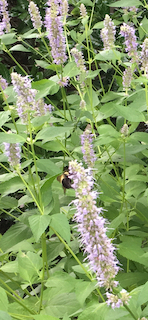
Native plants have virtue. They’re good for the environment. Planting them is the right thing to do. Planting them may even save the planet. How could any gardener or landscape designer not choose native plants?
I confess to reacting with a bit of resistance when I first heard statements such as these. Attending lectures showcasing native gardens that looked wilder than nature but not as beautiful made it difficult to join the native plant movement. Plant options seemed to diminish as gardening became an ethical act. Proponents were passionate, but what was missing from most presentations and publications was data – data showing that individual gardeners using native plants makes a difference.
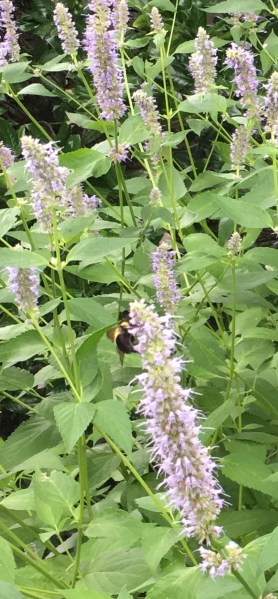
The data are there, have been there, in books such as Doug Tallamy’s Bringing Nature Home1, but it was a research article that finally caught my attention: “Nonnative plants reduce population growth of an insectivorous bird” in the November 6, 2018 issue of PNAS (Proceedings of the National Academy of Sciences)2. A detail-rich description of the impact of nonnative plants on the food supply of chickadees (also by Tallamy, with Desirée Narango as lead author and Peter Marra as co-author), the article addresses questions about the assumed benefits of nonnative biodiversity and draws a clear picture of the interrelationships that have evolved over time among birds, their insect food sources, and the plants that support the life cycles of insects. And the article provides a useful rule for designing a garden – keep nonnative plants to less than 30% of total biomass.
Where to start if you’re new to designing with native plants? Essential Native Trees and Shrubs for the Eastern United States3 is a good resource to consult for identifying plants that form the structure of the garden. Each profile describes how the plant is used in the landscape, its characteristics in different seasons, its form, color, texture, and culture, and plants found growing nearby in the wild or that pair well in the garden. Plant characteristics are summarized in tables that make it easy to select trees for narrow spaces, trees with attractive bark, or shrubs that provide food for birds.
A useful companion for identifying native perennials is Native Plants for Wildlife Habitat and Conservation Landscaping: Chesapeake Bay Watershed4, which summarizes growing conditions and attributes for ferns, grasses, herbaceous plants, and vines, in addition to trees and shrubs.
Pull out invasive Barberry and plant wildlife-friendly Yaupon Holly (Ilex vomitoria). Switch out the Crape Myrtle for an Eastern Redbud cultivar (Cercis canadensis). Trade four-season Nandina for three-season Witherod Viburnum (Viburnum nudum, Viburnum cassinoides) and let the show of fruit in summer and fall and the birds that follow make up for the loss of winter interest.
If preserving native plants, supporting bird-insect relationships, or bringing more butterflies and bees to the garden are not convincing arguments, consider another reason to plant native: many of the plants are flat-out gorgeous.
Notes
1. Tallamy, Douglas W. Bringing Nature Home: How You Can Sustain Wildlife with Native Plants. Updated and expanded paperback edition, 2009. Portland, Oregon: Timber Press.
2. Dove, Tony and Ginger Woolridge. Essential Native Trees and Shrubs for the Eastern United States. 2018. Watertown, Massachusetts: Charlesbridge.
3. Narango, D. L., D. W. Tallamy, and P. P. Marra. 2018. Nonnative plants reduce population growth of an insectivorous bird. Proceedings of the National Academy of Sciences of the United States of America. 115: 11549-11554.
4. Slattery, Britt E., Kathryn Reshetiloff, and Susan M. Zwicker. 2003, 2005. Native Plants for Wildlife Habitat and Conservation Landscaping: Chesapeake Bay Watershed. U.S. Fish & Wildlife Service, Chesapeake Bay Field Office, Annapolis, MD. 82 pp. (Also see online at https://www.fws.gov/chesapeakebay/pdf/NativePlantsforWildlifeHabitatandConservationLandscaping.pdf)
If you’d like to read more . . .
Clem, C. S., and D. W. Held. 2018. Associational interactions between urban trees: are native neighbors better than non-natives? Environmental Entomology. 47: 881-889.
Narango, D. L., D. W. Tallamy, and P. P. Marra. 2017. Native plants improve breeding and foraging habitat for an insectivorous bird. Biological Conservation. 213: 42-50.
“Native Plant Finder (Beta).” National Wildlife Federation. Accessed May 27, 2019. https://www.nwf.org/NativePlantFinder/
Poythress, J. C., and J. M. Affolter. 2018. Ecological value of native plant cultivars versus wild-type native plants for promoting hemipteran diversity in suburban areas. Environmental Entomology. 47: 890-901.
Note: The original draft of this post was written on May 28, 2019.
Virginia Sweetspire – A Close Look at a Native Shrub
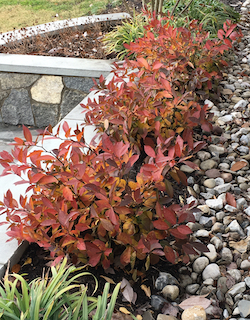
Itea virginica – Virginia Sweetspire – is recognizable in the landscape not for its memorable shape so much as its impact when planted as a mass. A close look reveals the individual features that combine so well to create this effect:
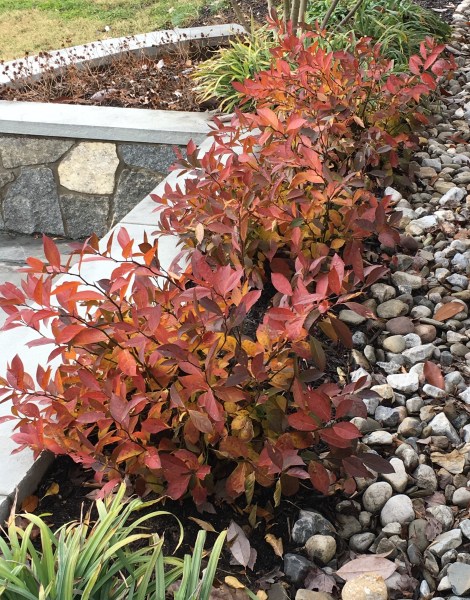
- New leaves with finely notched edges thinly outlined in red. The leaves are oblong in shape, slightly folded, and grow to about 1 1/2” in length in cultivars such as ‘Little Henry’.
- Arching spires of flower buds that extend above the foliage and open in summer, usually June or July. Each spire is dense with small white, lightly scented five-pointed flowers that last for several weeks and are a good food source for bees.
- Over a long period in fall, a kaleidoscope of leaf color that blends ruby, purple, and yellow, in stages or simultaneously.
- Slightly wiry and kinked maroon stems that become visible as the leaves drop and stand out against contrasting backgrounds such as stone, wood, or fresh snow.
A native shrub with a range that extends from Texas to Illinois, east to Pennsylvania and south to Florida, Sweetspire does well in wet soils and is a good choice for rain gardens but also can manage drought. Sun requirements range from full sun to part shade, with more intense flowering and fall color in full sun. In the warmer areas of Zones 5 to 9, its plant hardiness range1, Sweetspire may show semi-evergreen tendencies, with a portion of leaves holding on during winter and dropping suddenly to be replaced by new growth. Disease tolerance is good, with leaf spot one of few potential problems.
Two of the better known cultivars are ‘Henry’s Garnet’ and ‘Little Henry’. ‘Henry’s Garnet’ typically grows up to 4’ high and 6’ wide, with ‘Little Henry’ a smaller version at 2’ high and 2.5’ wide.2
Sweetspires are suckering shrubs and expand by sending out shoots from roots or lower stems. Pruning helps control this growth and reduces the density of the interior stems, creating a more shapely plant. Sweetspires bloom on old wood (the previous year’s stems rather than new growth in the current year) and should be pruned after flowering to allow new buds to develop throughout the rest of the year.
A member of the Order Saxifragales3, Sweetspire is related to several other shrubs with delicate flowers and good fall color, including Fothergilla, Witchhazel, and Winterhazel. The flower shapes are different – bottlebrush for Fothergilla, ribbon-like starbursts scattered along the branches for Witchhazel, and dangling chains for Winterhazel – but from an aesthetic perspective they share a kind of quiet beauty.
To leverage this quietness and take advantage of the rich color in autumn, plant Sweetspire in clusters or long borders. The arching flowers and fall foliage are striking when multiplied.

Virginia Sweetspire Leaves

Closeup of Virginia Sweetspire Leaves

Virginia Sweetspire Fruit
Notes
1. “USDA Plant Hardiness Zone Map.” Agricultural Research Service. U.S. Department of Agriculture. Accessed March 3, 2019. https://planthardiness.ars.usda.gov/PHZMWeb/Default.aspx
2. “Itea virginica ‘Henry’s Garnet’” and “Itea virginica ‘Sprich’ LITTLE HENRY.” Plant Finder, Missouri Botanical Garden. Accessed March 3, 2019. http://www.missouribotanicalgarden.org/PlantFinder/PlantFinderDetails.aspx?taxonid=249812&isprofile=1&basic=garnet and http://www.missouribotanicalgarden.org/PlantFinder/PlantFinderDetails.aspx?taxonid=249813&isprofile=1&basic=little%20henry
3. “Itea virginica.” Integrated Taxonomic Online Database. Accessed March 2, 2019. https://www.itis.gov/servlet/SingleRpt/SingleRpt?search_topic=TSN&search_value=24202#null
If you’d like to read more . . .
Chadwick, Pat. “Virginia Sweetspire.” The Garden Shed, Vol. 3, No. 6, June 2017. Piedmont Master Gardeners, Charlottesville – Albemarle County, Virginia. Accessed March 2, 2019. https://piedmontmastergardeners.org/article/virginia-sweetspire/
Dirr, Michael A. Manual of Woody Landscape Plants. Sixth Edition. Champaign, Illinois: Stipes Publishing L.L.C., 2009. p. 568-570.
“Itea virginica.” Chesapeake Bay Native Plant Center. Alliance for the Chesapeake Bay and U.S. Fish and Wildlife Service. Accessed March 2, 2019. http://www.nativeplantcenter.net/plants/itea-virginica/
“Itea virginica.” NC State Extension. Accessed March 2, 2019. https://plants.ces.ncsu.edu/plants/all/itea-virginica/
“Itea virginica (Virginia sweetspire).” Native Plants of North America Plant Database. The University of Texas at Austin Lady Bird Johnson Wildflower Center. Accessed March 2, 2019. https://www.wildflower.org/plants/result.php?id_plant=ITVI
“Plants Profile for Itea virginica (Virginia Sweetspire).” USDA, NRCS. 2019. The PLANTS Database (http://plants.usda.gov, 3 March 2019). National Plant Data Team, Greensboro, NC 27401-4901 USA. https://www.plants.usda.gov/core/profile?symbol=ITVI
Note: The original draft of this post was written on March 3, 2019.
Edgings Plant Bio #3
Edges, Spaces, Garden Design
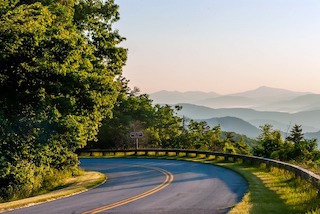
Note: The original draft of this post was written on December 8, 2018.
Edges define and create spaces, and these spaces can become important design elements, in a landscape, along a roadway, or in the home garden.
In his book Introduction to Landscape Design, John L. Motloch describes the concept of spatial edge, noting that “the spatial edge near eye level is crucial in visual perception.” Expanding upon this idea, Motloch continues:
“Successful spaces usually have edges that screen external elements that would otherwise destroy desired sense of place and that enframe views to promote this sense. Unsuccessful spaces tend to have poorly defined or improperly formed spatial edge. Spatial edge is important in helping people discover space in an appropriate manner.”1
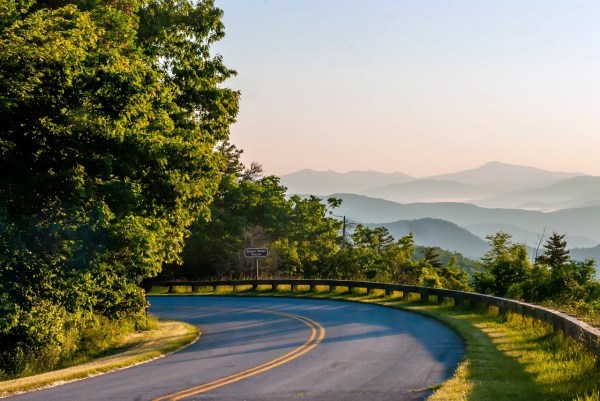
On a recent drive along the Blue Ridge Parkway, the value of spatial edges was easy to appreciate. Sloping, winding, neatly maintained buffers of grass separate the pavement from the trees, a visual framing that creates a foreground and makes it easier to appreciate the woods of the Parkway and the mounds of mountains in the distance. The grassy shoulders are designed to flow naturally, following the curve of the Parkway and the rise and fall of the land, and the movement is mesmerizing.
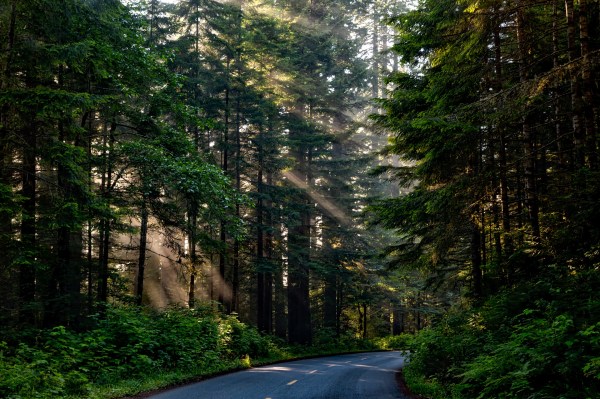
Without the shoulders the drive would be a lovely meander through the woods, and that’s what we found along other roads in the area, particularly when crossing the Pisgah National Forest, and when hiking certain trails in the southeastern quadrant of nearby Great Smoky Mountains National Park. The trees are close, filling one’s entire line of sight. The road or trail provides a narrow slice of perspective, with trunks and branches and leaves within reach, and the result is beautiful and serene. But the feeling is not the same as when viewing a scene with a well-crafted spatial edge.
Brookside Gardens in Montgomery County, Maryland presents another example of this principle. Look across the lawn sloping down to the woods of tulip trees and oak and hickory. A pond and Japanese tea house and rock garden with conifers rest in the middle view of this extensive buffer. Here you’re able to see what cannot be seen when on a trail in the woods of the same park – the edge, which exposes the full length of the trees’ trunks, the density with which they’ve grown to create the woodland, and the cloud-like movement of their crowns. The setting sun creates shadows along the ridges of the bark and reflects off the turning leaves. It’s a composed scene that creates a kind of living painting, a completely different sense from being in the midst of the woods.
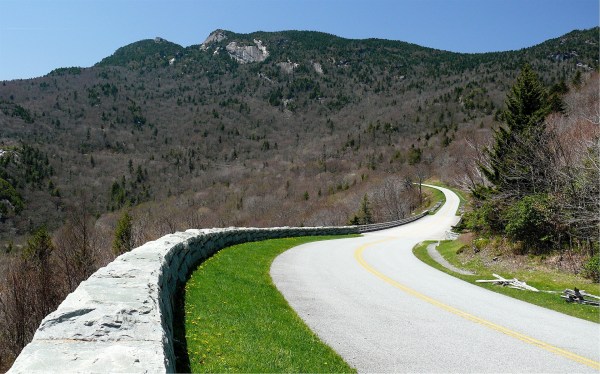
What appears to be a simple design practice – creating a buffer for viewing – transforms these landscapes. Remove the space created by the edge and the response to the scene would be completely different.
It’s a useful exercise to keep in mind when walking around a public park or your own garden. Imagine the scene with and without a defined edge or buffer – the stretch of lawn, the mulched bed, the fence or wall – and consider the impact on the viewer. It’s remarkable how even the most ordinary of views and basic combination of plants can improve when controlled through the use of a thoughtful edge.
Notes
1. Motloch, John L. Introduction to Landscape Design. Second Edition. John Wiley & Sons, 2001. p. 190.
If you’d like to read more…
“Brookside Gardens.” Montgomery Parks. Montgomery County Department of Parks. Accessed December 9, 2018. https://www.montgomeryparks.org/parks-and-trails/brookside-gardens/
“Designing the Blue Ridge Parkway.” Blue Ridge Parkway. National Park Service, U.S. Department of the Interior. May 31, 2016. Accessed December 9, 2018.
https://www.nps.gov/blri/learn/historyculture/designing-the-blue-ridge-parkway.htm
Ford, Mike and Liz Sargent. “The Blue Ridge Parkway: Exemplifying the Evolution of the NPS Planning and Design.” National Center for Preservation Technology and Training. National Park Service, U.S. Department of the Interior. This presentation was part of A Century of Design in the Parks: Preserving the Built Environment in National and State Parks, June 21-23, 2016, Santa Fe, New Mexico. Accessed December 9, 2018. https://www.ncptt.nps.gov/blog/the-blue-ridge-parkway/
Photo Attributions
All photos were downloaded from Pixabay and are free for commercial use with no attribution through a Creative Commons CC0 (Public Domain Dedication).
Grace in the Garden: The Hinoki Cypress
Note: The original draft of this post was written on September 1, 2018.
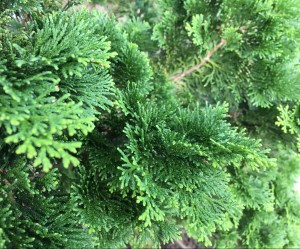
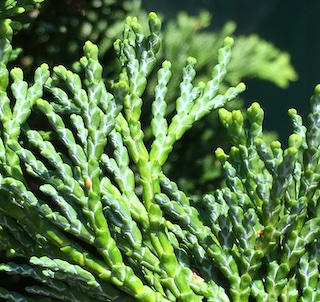
Chamaecyparis obtusa, the Hinoki Cypress (or Falsecypress), stands quietly in the garden, commanding attention but requiring minimal care. Pruning shears rarely are needed for this self-contained evergreen that seldom produces stray or unbalanced growth. From the upright trunk, branches extend horizontally into flattened, slightly drooping sprays of tiny, scale-like leaves that end in a ruffled edge. Against a backdrop of garden stone or the bare grain of a wood fence, the Hinoki takes on the appearance of sculpture. It gives the sense of keeping watch.
Perhaps this presence contributes to the status of the Hinoki as an honored tree in Japan. Its aromatic wood is a favored choice for Japanese soaking tubs, and for centuries, the preferred material for constructing temples and other traditional structures.1 Logging has reduced the number of Hinoki Cypresses in the wild, which may exceed 100 feet in height, and in Japan the species is listed as Near Threatened by the International Union for Conservation of Nature and Natural Resources.2 The domesticated scene is different. In Japanese gardens, and throughout Europe and the U.S., the Hinoki is planted in increasing numbers as gardeners choose from an expanding variety of cultivars.
Those cultivars range from six-inch golden globes perfect for containers to the dark green ‘Nana Gracilis’, a slender dwarf form in comparison to the species, which grows to six feet in height and three to four feet in width and works well as a focal point in the landscape.
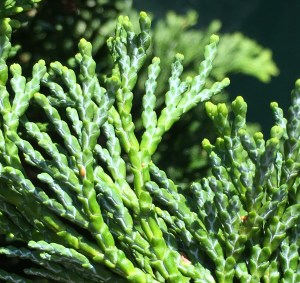
Hinoki Cypresses thrive in the humidity of the Mid-Atlantic but are not swamp creatures; the moist soil they require must have good drainage. They prefer sun and are able to withstand drought, but as with many evergreens, need to be protected from freezing winter winds.
Why Falsecypress? The Hinoki is a member of Cupressaceae, the cypress family of conifers, but has smaller cones and slightly different foliage than a true cypress.3 The cones develop in clusters, have distinctive markings, may require close viewing to find, and are more ornamental than a draw for wildlife.
The Hinoki is a plant for the eye. With its sculptural form and measured growth, it’s an evergreen that adds grace to the garden.
Notes
1. Kennedy, Corinne. “Hinoki: A Revered Conifer.” Seattle Japanese Garden. December 16, 2016. https://www.seattlejapanesegarden.org/blog/2016/12/16/hinoki.
2. Farjon, A. 2013. Chamaecyparis obtusa. The IUCN Red List of Threatened Species 2013: e.T42212A2962056. http://dx.doi.org/10.2305/IUCN.UK.2013-1.RLTS.T42212A2962056.en. Downloaded on 01 September 2018.
3. The Editors of Encyclopaedia Britannica. “False cypress.” Encyclopaedia Britannica. December 22, 2017. https://www.britannica.com/plant/false-cypress.
If you’d like to read more . . .
“Chamaecyparis obtusa in Flora of China @ efloras.org.” Flora of China. Vol. 4, Page 68. Accessed September 1, 2018. http://www.efloras.org/florataxon.aspx?flora_id=2&taxon_id=200005410.
“Chamaecyparis obtusa – Plant Finder.” Missouri Botanical Garden. Accessed September 1, 2018. http://www.missouribotanicalgarden.org/PlantFinder/PlantFinderDetails.aspx?taxonid=279589&isprofile=1&basic=chamaecyparis%20obtusa.
“Conifer Species: Chamaecyparis obtusa.” American Conifer Society. Attributed from: Chris Earle, The Gymnosperm Database, ©2012. Accessed September 1, 2018. http://conifersociety.org/conifers/conifer/chamaecyparis/obtusa/.
“Conifer Trinomial: Chamaecyparis obtusa ‘Nana Gracilis’.” American Conifer Society. Accessed September 1, 2018. http://conifersociety.org/conifers/conifer/chamaecyparis/obtusa/nana-gracilis/.
Gilman, Edward F. and Dennis G. Watson. “Chamaecyparis obtusa: Hinoki Falsecypress.” ENH315. Environmental Horticulture, Florida Cooperative Extension Service, Institute of Food and Agricultural Sciences, University of Florida. Original publication date November 1993. Revised December 2006. Reviewed May 2011. https://edis.ifas.ufl.edu/pdffiles/ST/ST15600.pdf.
SelecTree. “Chamaecyparis obtusa Tree Record.” 1995-2018. September 1, 2018. https://selectree.calpoly.edu/tree-detail/chamaecyparis-obtusa.
Edgings Plant Bio #2
Plants First, Plants Last: The Role of Plants in Garden Design
Note: The original draft of this post was written on July 6, 2018.
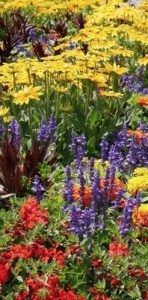
At a lecture earlier this year hosted by Montgomery County’s Brookside Gardens, David Culp, author of The Layered Garden, explained the garden design process at Brandywine Cottage, his home in southeastern Pennsylvania. Plants spoke first, Culp listened and responded, and a garden evolved, built on plants selected for sustainability and designed (or layered, as Culp describes it) for visual appeal in every season.
The gorgeous, plant-rich slides that accompanied Culp’s talk showed color and texture and placement that drew gasps from the audience. Healthy, glowing perennials appeared in impressive masses, arranged with an expert, artful hand. Culp described the purpose of gardening as the creation of take-your-breath-away moments, and Brandywine appears to present these moments at every turn. It is a kind of theater, as plants, in countless combinations and arrangements, emerge and retreat throughout the year, and it is a tribute to the affinity Culp expressed for being overwhelmed by nature.
It is a garden of plants first.
A few weeks earlier I had been reading about John Brookes, the recently deceased English landscape designer and educator known for promoting garden design as a process accessible to the average homeowner. For Brookes, plants did not drive design but were one practical component, and often, if not always, the last. In his blog, Brookes made a distinction between gardeners and garden designers:
A gardener’s primary concern is for the well being of his plants, the soil in which they grow, their orientation, and their general husbandry.
A garden designer’s primary concern is for the well being of his clients. It might eventually encompass plant material, but that is often way down the line.1
How, I wondered, would the audience listening to Culp respond to a garden that “might eventually encompass plant material,” a garden of plants last?
 In The Book of Garden Design, published in 1991, Brookes described how easy it is to get caught up in plant selection, with the result being “a restless garden with little unity of thought between concept, plan, and planting.” He encouraged a more structured approach, with design principles that include proportion and shape, patterns and styles, and with the areas to be planted viewed initially as “bulky, three-dimensional shapes” to be combined and recombined to create a satisfactory plan. Brookes then provided a framework for selecting plants: the five categories of specials (focal points), skeletons (year-round structure), decoratives (flowering shrubs), pretties (herbaceous perennials), and infill (bulbs, annuals, biennials). It is the problem-solving approach of an engineer.2
And yet, the results Brookes achieved, to my eye, certainly take one’s breath away.
Compare photos of Brandywine Cottage and Denmans, the garden Brookes designed at his West Sussex home in England.3 From a visual perspective, both designers have transformed their land into memorable gardens. But what distinguishes them? Why is it that they feel different? The number of plant varieties, for one, but also the use of space – one embeds the viewer, the other creates spaces for viewing.
Brookes said, “I think of the garden masses (the planting or the structural features) as the “positives” and the spaces between them (the grass or paving) as the “negatives,” and the balance between the two is an important factor in my garden designs.” The relationship between open and planted spaces, he wrote, creates the feeling of being enfolded.4
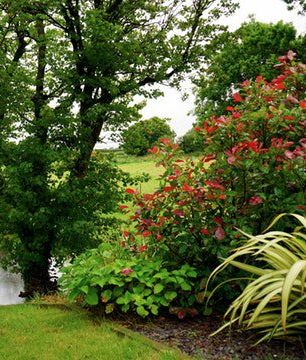
Part of the magic of garden design is that the purpose of a garden is as individualized as each gardener and client. In today’s era of the wild garden and growing respect for the value of native and sustainable plants, Culp’s recommendation to “consider a garden as living sculpture” has a lot of appeal.5 But Brookes continues to provide a practical structure for solving the problems of garden design, for bringing harmony through the balance of positives and negatives. Some people may not want this structure – they want to be embedded with the plants, as many as possible. But for others, the garden design of Brookes is a way to stand back and create spaces from which to appreciate plants, even when considered last in the design process.
Notes
1. Brookes, John. “Gardener or Garden Designer?” John Brookes Raves & Rants, July 23, 2016. Accessed July 14, 2018. https://johnbrookesgardendesign.blogspot.com/2016/07/normal.html?view=magazine
2. Brookes, John. The Book of Garden Design. Macmillan, 1991. p. 114; 120-133.
3. See the David Culp website (http://davidlculp.com/) for photos of Brandywine Cottage and Denmans Garden (http://denmans.org/) or John Brookes Landscape Design (http://johnbrookes.com/) for photos of projects by John Brookes.
4. Brookes, John. The Book of Garden Design. Macmillan, 1991. p. 40, 42.
5. Culp, David L. The Layered Garden: Design Lessons for Year-Round Beauty from Brandywine Cottage. Timber Press, 2012. p. 33.
Photo Attributions
Photo 1: Downloaded from Pexels – Source: Pixabay
Photo 2: Downloaded from Pexels – Source: Mikes Photos
Sweetbay or Swamp? Either Way, a Magnolia to Consider
Note: The original draft of this post was written on June 22, 2018.
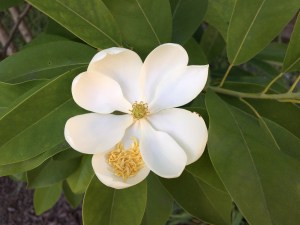
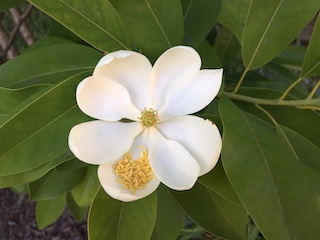
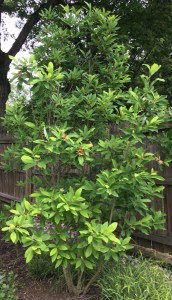
A native of the eastern U.S., the Sweetbay Magnolia (Magnolia virginiana) grows as a small tree or multi-stemmed shrub with an airy feel, more delicate than the better-known Southern Magnolia. It lightens the garden with leaves that open chartreuse in spring, grow longer than wide, and show silver when turned by the wind. The clustered leaves provide a clear view of the plant’s graceful stems, and in a breeze, the leaf clusters seem to float.
Cream-colored, cup-shaped flowers dot the plant from spring into summer and give off a soft, sweet lemon scent. As the flowers fade, the petals turn caramel, curl, and drop. Fruit follows, cones of bright red, glossy seeds that attract flickers and jays.
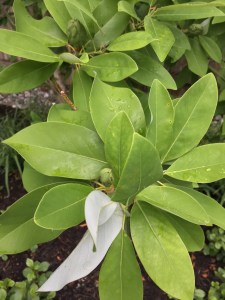
In fall, the Sweetbay’s leaves display muted shades of yellow, and in Zone 7, a few leaves may remain throughout winter.
When I think of this magnolia, I call it a Sweetbay, because it is one sweet shrub, in scent and shape. But it’s also known as a Swamp Magnolia, a reflection of its native habitat. Unlike other magnolias, it does well in wet soil, such as rain gardens, and in southern swamps it typically grows as a tree, 50 to 60 feet in height.
The first magnolia introduced to European gardens, in 1688, the Sweetbay now faces challenges at home and is listed as an endangered species in Massachusetts and New York and a threatened species in Pennsylvania and Tennessee.
Whether you think of it as a moisture-loving Swamp or a lemony Sweetbay, it’s a magnolia to consider.
If you’d like to read more . . .
“Magnolia virginiana in Flora of North America @ efloras.org.” Flora of North America Editorial Committee, eds. 1993+. Flora of North America North of Mexico. 20+ vols. New York and Oxford. Vol. 3. Accessed June 23, 2018. http://www.efloras.org/florataxon.aspxflora_id=1&taxon_id=220008034.
“Magnolia virginiana | NATIVE PLANT CENTER.” Chesapeake Bay Native Plant Center. Accessed June 17, 2018. http://www.nativeplantcenter.net/plants/magnolia-virginiana/.
“Magnolia virginiana – Plant Finder.” Missouri Botanical Garden. Accessed June 16, 2018. http://www.missouribotanicalgarden.org/PlantFinder/PlantFinderDetails.aspx?taxonid=282522&isprofile=0&letter=M.
“Magnolia virginiana (Sweetbay) | NPIN.” Lady Bird Johnson Wildflower Center – The University of Texas at Austin. Accessed June 16, 2018. https://www.wildflower.org/plants/result.php?id_plant=MAVI2.
“Plants profiles for magnolia virginiana (sweetbay).” USDA, NRCS. 2018. The PLANTS Database (http://plants.usda.gov, 16 June 2018). National Plant Data Team, Greensboro, NC 27401-4901 USA. Accessed June 16, 2018. https://plants.usda.gov/core/profile?symbol=MAVI2.
“Sweetbay Magnolia | Chesapeake Bay Program.” Chesapeake Bay Program. Accessed June 16, 2018. https://www.chesapeakebay.net/S=0/fieldguide/critter/sweetbay_magnolia.
Tropicos.org. Missouri Botanical Garden. Accessed June 23, 2018. http://www.tropicos.org. [Search ‘magnolia virginiana’ in Quick Name Search.]
Edgings Plant Bio #1
 Edgings Garden Research and Design