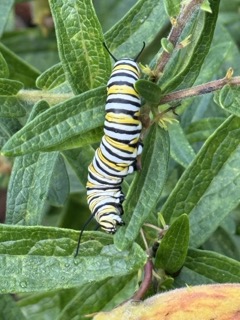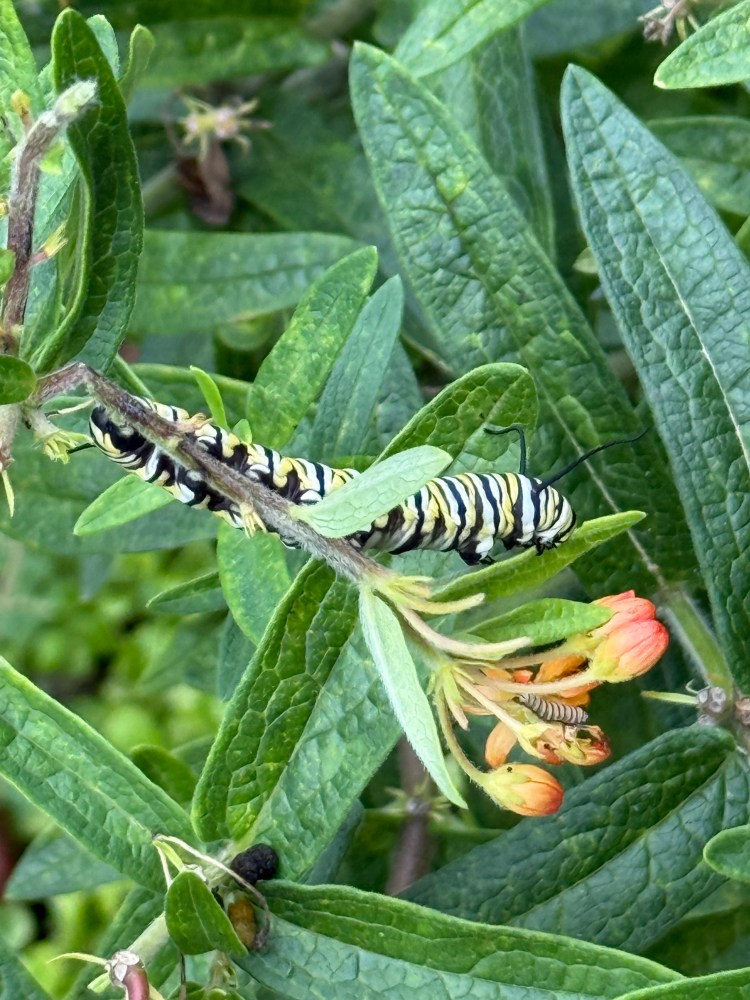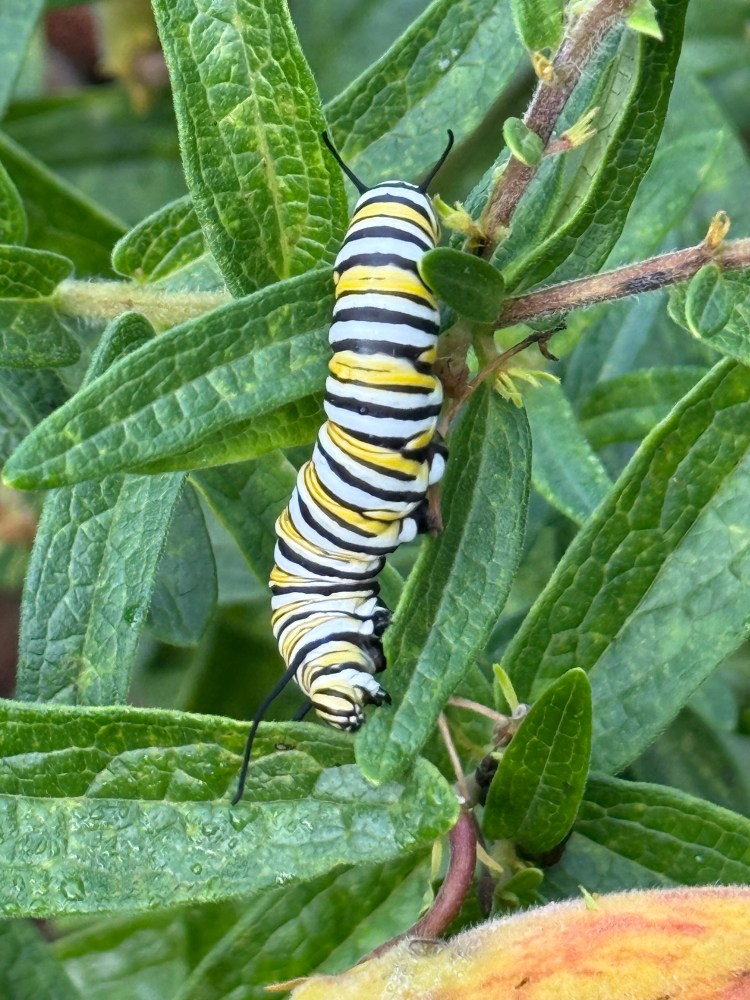
Finally, a monarch! And not just one caterpillar, but two, with others, I hope, hidden among the late-season foliage.
I’ve been checking the milkweed regularly since early summer and changed that practice to daily after seeing a few monarch butterflies visiting the garden over the last two weeks. Disappointment was the result until August 18, when I spotted a large larval specimen chewing its way down a leaf, followed about an hour later with sighting of a miniature version.
… and the second
The first monarch caterpillar
The milkweed on which the eggs were laid is butterfly weed, or Asclepias tuberosa, noted for eye-catching orange blossoms and dark green narrow leaves. My guess, based on information provided by the University of Maryland Extension and Monarch Watch, is that the egg-laying took place around August 4 and August 14, with each egg laid by a different female. If circumstances allow, the larger caterpillar will form a chrysalis in the next few days and metamorphose from larva to butterfly around September 1. The smaller caterpillar will follow about ten days later.
The egg-laying butterflies most likely were part of the summer generation, which lives for up to five weeks, but the two caterpillars, or larvae, may be members of the year’s final generation. After transforming into butterflies, they’ll be on their way to Mexico to overwinter, a distinctive function of that generation. Next spring, they’ll migrate north, to mate and continue the reproductive cycle.
A lot must go right for a single monarch to be created. With luck, the two caterpillars on the butterfly weed will soon be drying their wings and flying off to join millions of other monarchs journeying south.
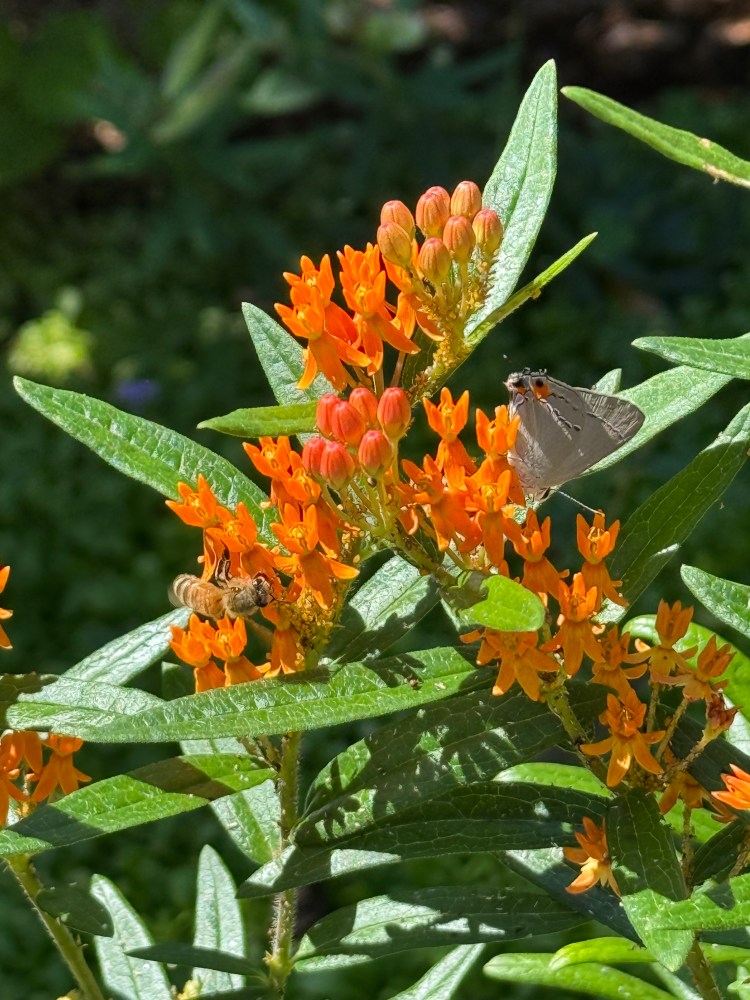
Butterfly Weed (Asclepias tuberosa) with Gray Hairstreak and Honey Bee
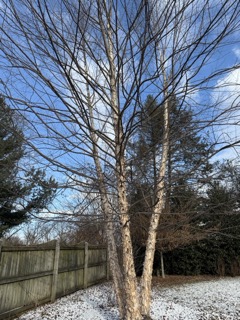
The sky begins to lighten in shades of rose and pink, and a golden-crowned kinglet is a few thousand feet above ground, looking down on the Maryland suburbs of Washington, D.C. Brick, concrete, and pavement are everywhere: high-rise buildings, roadways, parking lots, and roofs but also lawns, shrubs, and then the crowns of trees, lots of trees. The kinglet descends into a neighborhood, and moving from yard to yard, finds among the vegetation a familiar shape. A river birch, its three trunks gracefully angled outward, the bark shaggy, the leaves jagged-edged and widely spaced, rises above the shrubbery. The kinglet stops to investigate, because it knows this tree is likely to hide among the crevices of its bark the spiders, mites, and other small arthropods it prefers to eat.
Every spring and fall, often in late March or early April and toward the end of October, a kinglet or two (or maybe more that I don’t see) will stop by this tree, in my suburban garden. For a few minutes, with movements so quick it could be mistaken for falling leaves, it drops from a top branch to the next and the next, on down, searching for insects. Reversing its path, it moves upward, and then again down, flicks sideways, dangles, follows a branch to its tip, and continues the acrobatics.
Why so frenetic? Because it’s in a race to replenish the calories it’s constantly losing, through daily life and migration, southward in the fall from as far north as the spruce and pine forests of Canada, and northward in the spring from as far south as Florida and northeastern Mexico.
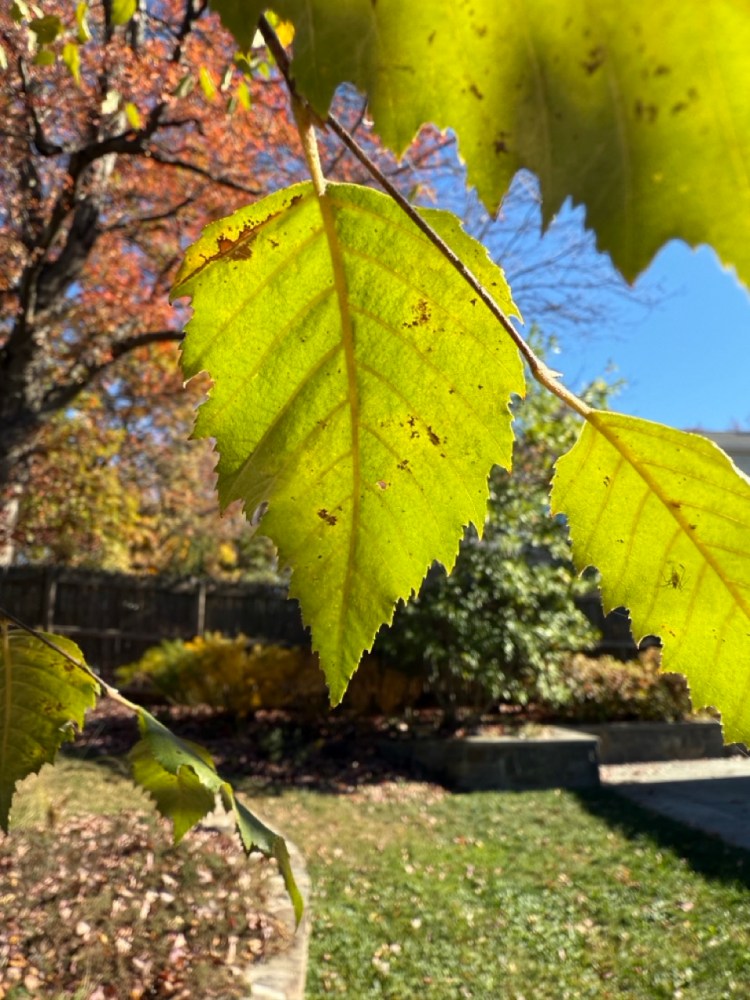
River Birch Leaves
Life as a golden-crowned kinglet used to begin primarily in the boreal forest of the United States and Canada, but the breeding range has been extending southward, as close as the Appalachian Mountains of western Maryland, western Virginia, and southeastern West Virginia. It’s a shorter-distance migrant, but flying a thousand miles twice a year, or even hundreds of miles, when you weigh about the same as two or three pennies seems worthy of recognition. And when a kinglet stops by the birch in my yard–when I’m lucky enough to spot it among the branches–I think about all it has seen and will see and how amazing it is that it survives.
Golden-crowned kinglets are not an endangered or threatened species, at least in the eastern U.S., but that may be because of the increasing number of spruce trees being planted, which have helped expand its breeding range. A few spruce and hemlock dot the neighboring yards, but the birch, a genus of trees familiar from the kinglet’s breeding grounds, is not common in the neighborhood. I wonder, would kinglets stop by my garden if it had not been planted? It is a river birch cultivar, Betula nigra ‘Heritage’. Selected for its ability to withstand the heat and drought of Maryland summers, it has adapted well to its site and has grown 18 feet in five years. As a cultivar, it most likely is not a host for as many moths and butterflies as straight species of river birch, but its chances for survival in this climate are greater. It has done what I had hoped, which is to supply food–caterpillars, flower buds, seeds–to resident and migrating birds, kinglets among them.
During spring and early summer, the birch receives visits from hungry house finches, goldfinches, and the occasional downy woodpecker, and song sparrows in particular seem to enjoy perching high in the branches to sing. It plays a significant role in supporting wildlife, and it is lovely in the garden.
That any creatures find what I have planted for them–trumpet honeysuckle and cardinal flower for ruby-throated hummingbirds, butterfly weed for monarch butterflies, heath aster and agastache for bees–continues to astonish. That golden-crowned kinglets passing through repeatedly find the birch is an argument for planting even more intentionally for wildlife. It feels a bit like a lure for my benefit, but it not only supplies wonder–it assists in kinglet survival.
Consider a night in October as an example, a night close to when I spotted the kinglet. On October 19, 2024 an estimated 328,700 birds flew over Montgomery County, Maryland according to The Cornell Lab’s BirdCast. At the time of greatest activity, an estimated 66,500 birds were in flight, winging across at an average of 17 miles per hour south to southwest and at an altitude of 4,500 feet. Among the likely species in flight, based on observations reported through eBird, were golden-crowned kinglets. Was the kinglet that stopped by my birch to refill its reserves among that crowd? As with monarch butterflies, if kinglet habitat disappears, or the habitat of other songbirds that flew across the county that night, and there no longer are stopover sites for refueling, what will happen to their populations?
So much occurs in nature that we do not see or sense. All that movement in the night skies, and we are often unaware. Migrating birds pass through, but we may not stop to think about where they came from or where they’re headed or even that they’re on a journey. How nature functions may feel overwhelming and unknowable, and it may seem there’s no way we can contribute to keeping it going. But we do have options, and one is to plant for wildlife, including birds.
Birds need food, the food that emerges from the ecosystems of native birches and oaks, willows and maples, and from elderberries, serviceberries, viburnums, and winterberries. They need food when they’re year-round residents and food when they’re migrating. And when you plant the food-supplying trees and shrubs birds need, the birds will stop. Patience is required, as it may take several growing seasons for a plant to mature enough to produce berries or serve as a host for butterfly and moth larvae. But that patience delivers the reward of watching as the birds–through their eyesight, auditory and other cues, and exploratory behavior–discover the habitat you’ve created. It may be a kinglet in a birch, a robin in a holly, a blue jay in a sweetbay magnolia, or a chickadee in an oak, but they will find what you plant. And often they will remember and return.
Notes
Cornell Lab of Ornithology. 2025. All About Birds. “Golden-crowned Kinglet.” Cornell Lab of Ornithology, Ithaca, New York. Accessed January 31, 2025. https://www.allaboutbirds.org/guide/gockin
Cornell Lab of Ornithology. 2025. eBird. “Golden-crowned Kinglet: Regulus satrapa.” Cornell Lab of Ornithology, Ithaca, New York. Accessed January 31, 2025. https://ebird.org/species/gockin
Sibley, David Allen. What It’s Like to Be a Bird. “Kinglets,” p. 124-125. New York: Alfred A. Knopf, 2020.
Swanson, D. L., J. L. Ingold, and R. Galati (2020). Golden-crowned Kinglet (Regulus satrapa), version 1.0. In Birds of the World (A. F. Poole, Editor). Cornell Lab of Ornithology, Ithaca, NY, USA. Accessed December 3, 2024. https://doi.org/10.2173/bow.gockin.01
Tallamy, Douglas W. Bringing Nature Home: How You Can Sustain Wildlife with Native Plants. Portland, Oregon: Timber Press, 2009.
Walk through suburban neighborhoods in Maryland, and it’s clear the use of native plants is increasing. Turf grass may continue to anchor most yards, but clusters of black-eyed susans (Rudbeckia hirta), coneflowers (Echinacea), and Joe-Pye weed (Eutrochium) are visible on many blocks, grouped together to create pollinator gardens or scattered among more traditional plantings.
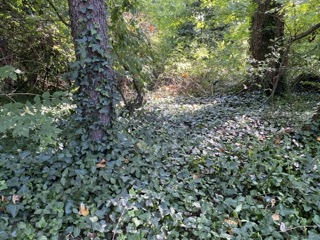
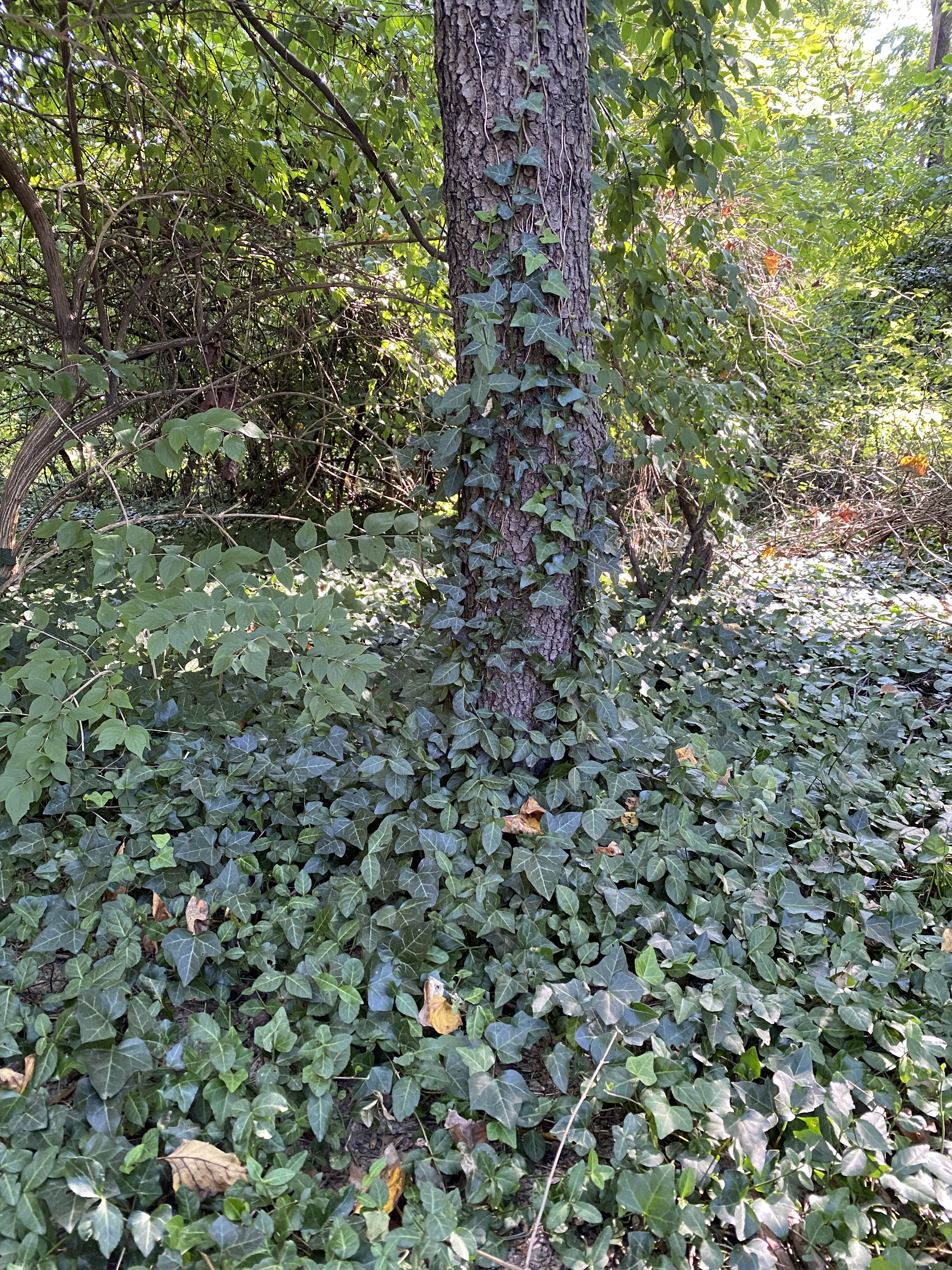
Invasive English Ivy, Honeysuckle, and Wintercreeper in a Local Maryland Park
Drive down the highways and back roads of Maryland, or wander through the state’s local and urban parks, and nonnative invasive vines, shrubs, and perennials are everywhere, choking or outcompeting the native vegetation. The lush green can be deceptive until you take a closer look and realize the woods are being overrun by some of the same plants that have been sold or are sold today in garden centers: English ivy (Hedera helix), a long-time landscape staple; barberry (Berberis), a shrub often used as an accent plant and known for its golden or crimson foliage; and porcelainberry (Ampelopsis brevipedunculata), a grape-like vine with berries in shades of purple and blue.
The Maryland legislature is paying attention.
In 2023, the Maryland General Assembly passed legislation, signed by Governor Wes Moore, to create the Maryland Native Plants Program. Developed in response to the public’s growing interest in native plants, and with an implementation date of July 1, 2024, the program will offer voluntary certification for native plant growers and garden centers, maintain a list of plants certified as native for purchase, develop a branding program so consumers can identify certified native plants when shopping, and hire a native plant specialist through the University of Maryland Extension Services to coordinate efforts to educate Marylanders on the benefits of native plants.
In May of 2024, the governor signed the Agriculture – Invasive Plant Species – Regulation section of the Biodiversity and Agriculture Protection Act, which limits the sale of nonnative invasive plants in Maryland. The Act extends existing legislation, expanding the number of prohibited nonnative invasives and creating a process for recommending plants for designation as invasive. To keep the public informed, the Department of Agriculture will post on its Maryland Invasive Plants Prevention and Control webpage a list of plants identified as invasive in the state and banned from sale. The original list, developed in 2016 and known as Tier 1, includes nonnative invasives such as wintercreeper (Euonymus fortunei), lesser celandine (Ficaria verna), yellow iris (Iris pseudacorus), and Amur honeysuckle (Lonicera maackii), plants that are rampant in natural areas of Maryland.
These two pieces of legislation will make it easier for Maryland home gardeners and landscape designers to create gardens that are beneficial to wildlife, with plants that provide pollen, nectar, berries, foliage for developing butterfly and moth larvae, and nesting habitat, while reducing the inadvertent use of invasive plants that spread beyond gardens and overrun native species. By passing these laws, Maryland legislators responded to the community’s desire to plant more ecological gardens and also recognized that success is more likely if the process of identifying and obtaining appropriate native plants is no more difficult than purchasing traditional plants for the garden.
The state government’s efforts at educating the public about the value of native plants and controlling the spread of nonnative invasives are a welcome assist in keeping Maryland’s landscape biologically diverse and healthy.
Update (January 17, 2025): The certification program for plant growers is now active; see Maryland’s Best Native Plant Program for information. Certification is based on the percentage of native plants on the Commercial Maryland Native Plant List that are in a grower’s inventory. The Plant List provides numerous details for each plant, including growing conditions, dimensions, bloom time, and wildlife value, and is a useful guide to plant selection for consumers.
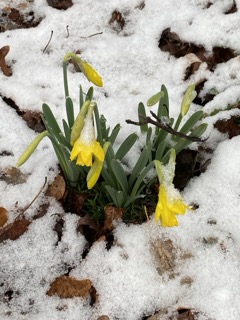
On March 6, I wrote, “The miniature irises in my garden, early spring-blooming bulbs, have already flowered and faded. The daffodils are in their prime, cheerily, ecstatically yellow. Blossom watches for the cherry trees around the Tidal Basin report the buds are close to opening, at least two weeks early. And yet Orion, the classic constellation of winter in this region, continues to appear in the night sky.”
Then, on March 18, “the only remnants of the irises are spindly spikes of foliage, most of the earliest blooming daffodils have crumpled, and the cherry trees at the Tidal Basin are at their peak, two weeks ahead of the average peak date as anticipated.”
And, “in my garden a second wave of daffodils is preparing to bloom, the serviceberry is about to join them, lilac leaves (leaves!) are emerging, and green mounds of new perennial foliage are pushing up everywhere amidst the covering of fall leaves: fire pinks and sun drops, alliums and salvia, asters and echinacea and penstemon.”
When all this activity began, I could only think of phenology–the study of when plants bloom and leaf out–and how phenological cycles have been affected by climate change. The USA National Phenology Network has data indicating how early or late spring occurs each year, and a Washington Post article published in March used this data to show that spring in the D.C. area began about 13 days earlier this year than in 1981. This readjustment of the timing of spring is not good. Plants, in addition to their aesthetic qualities, are interconnected with the lifecycles of insects. Flower too early or late, and the insects dependent on them for pollen and nectar are out of luck, while the plants’ needs for the pollination that creates each generation may go unmet.
If I were to sit down now with Louis Halle’s Spring in Washington (published in 1947) or Edwin Way Teale’s North With the Spring (published in 1951), how would their descriptions of the season compare with what I am seeing in 2024? I have a dusty (and accurate, I hope) memory of reading Tom Horton’s 1987 ode to the Chesapeake, Bay Country, in which he describes the herring run in Rock Creek Park occurring around the time the violets were blooming. Thirty-five years ago, the violets in my yard bloomed near the end of March. This year I found violets, mostly scattered around the lawn, opening about the same time as the miniature irises, and I wondered if the herring have survived.
I can’t deny the beauty when spring bursts forth in concentrated form. It’s a kind of horticultural rush, and there’s a desire for more. When will the baptisia emerge and bloom? Why haven’t I seen the turtleheads yet? Then I notice the amsonia, with buds opening while the stems are only about 18 inches high rather than the 30 inches I remember from the past. What’s going on here, and is this anomaly another response to a warming climate?
The garden continues to unfold. There’s no stopping it now, and I cannot slow it down. But I can do more than become entranced by the beauty of this condensed spring and immobilized by what it means. I can keep planting. And I can vote.
I don’t recall the first time I heard of Mt. Cuba Center, but for the last few years this native plant garden in the Brandywine Valley area of Delaware has been on my bucket list of Mid-Atlantic gardens to visit. In October, I was fortunate to spend part of a day roaming the site, soaking up its inspiration for native plant design.
Driving west from the village of Montchanin, the road to Mt. Cuba rises and falls with the terrain, winding past centuries-old and contemporary dwellings built of stone, property boundaries marked by well-maintained stone walls, and intimate stretches of road-hugging woods. The entrance to Mt. Cuba appears without much fanfare, a driveway that disappears up a hill and through the trees.
Along that drive are fences and walls, planted with trumpet honeysuckle vines intermittently spaced, and beyond that a beautiful rural scene. When the parking lot appears, it’s a tease for what’s to follow. With neat groupings of perennials between each row of vehicles, it feels soft and pretty. If this is the parking lot, I think, I can’t wait to see the South Garden, the formally planted native garden that I’m most interested in visiting.
The idea of creating a formal garden using native plants makes good design sense. It’s an approach that controls the wildness of native perennials and shrubs, which can overwhelm the senses when planted in dense communities. This control makes the garden more comprehensible, with recognizable parts combined to create an integrated whole. It’s not an attempt to replicate nature but to selectively highlight how amazing native plants can be, through the presentation of an organized space. Organization may be vertical (the varying heights of perennials, shrubs, and trees), horizontal (foreground, middle ground, and background), or by pattern (clusters or flowing sweeps of the same plant, with colors and textures grouped to lessen visual busyness). The number of species planted is limited and plenty of open space is available throughout the garden for viewing the composition.
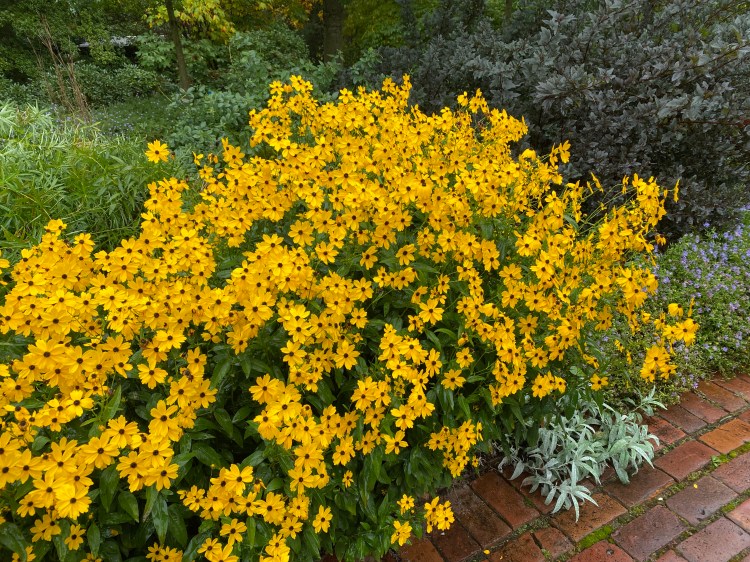
Coreopsis palustris “Summer Sunshine’, Mt. Cuba Center South Garden
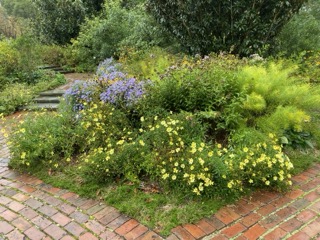
In Mt. Cuba’s South Garden in autumn, amsonia forms a feathery golden backbone, carrying across the different beds at a middle distance or in the background. Lavender asters spill onto the walkways, multi-stemmed ninebark punctuates the flow of perennials with wine-colored foliage, penstemon flower stems have been cut back to reveal the green and maroon basal foliage hugging the ground, and thigh-high Coreopsis palustris ‘Summer Sunshine’, almost shrub-like, startles with its flush of yellow flowers. What season is it again, I wonder, every time I come upon their vivid display around the garden.
The South Garden is a showcase for native cultivars, the cultivated varieties of straight species growing wild. Cultivars often appear tamer, with shorter heights and less legginess, a greater abundance of flowers, and leaf colors not commonly found in nature. Setting aside the debate about whether cultivars should be used in a native plant garden, from a design perspective, they can be stunning. They’re developed for the garden, and at Mt. Cuba they’re combined with a few straight species in beds bordered by winding brick walkways and areas of turf. The walkways provide a closeup of the planting arrangements and individual plants, while the expanses of turf allow a view of the sections that join to make up the South Garden.
View of Naturalistic Gardens, Mt. Cuba Center
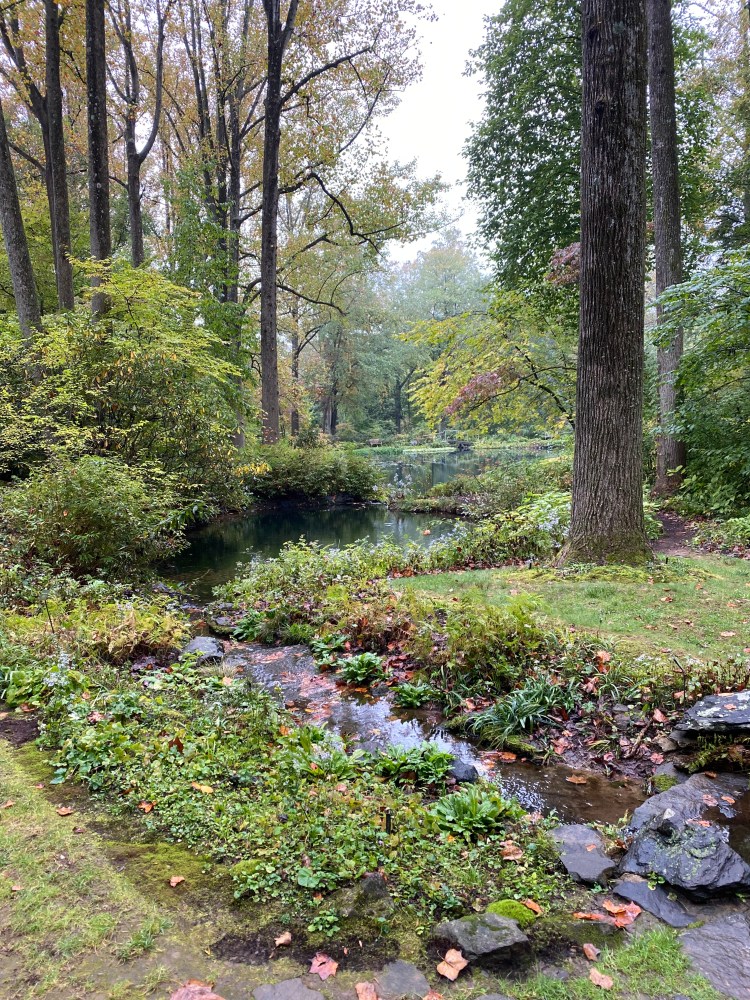
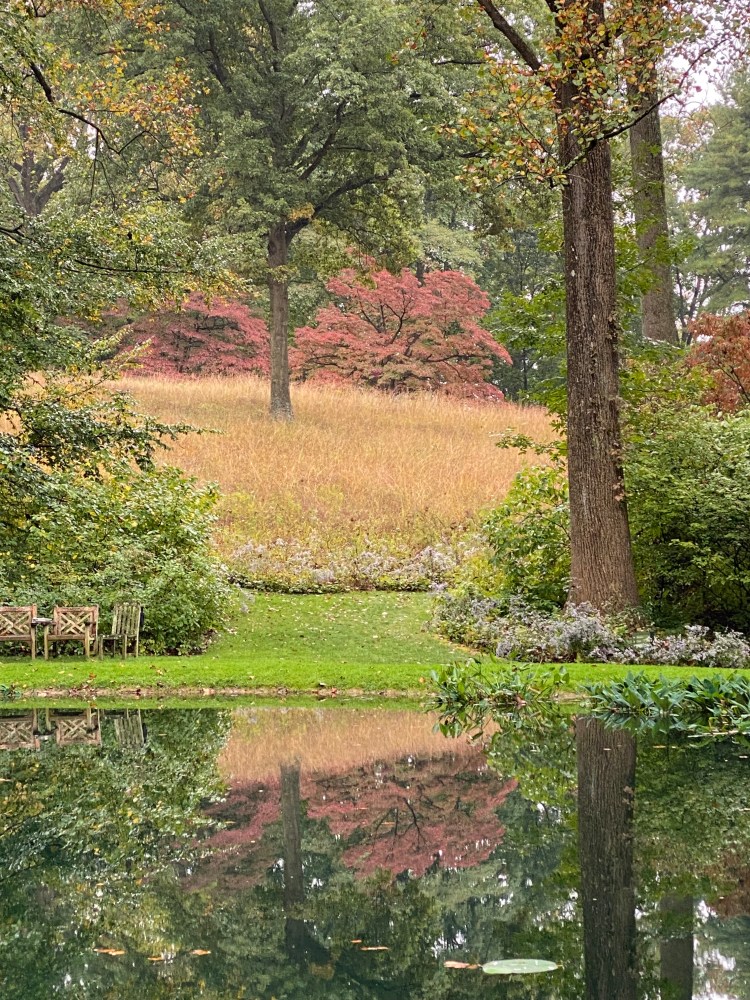
Near the South Garden is the Trial Garden, where native plants, including many cultivars, are assessed for hardiness and benefits to pollinators, such as production of nectar and pollen. Located beyond are the wilder but still designed Naturalistic Gardens. Straight species of native plants, including trees and shrubs, dominate in these gardens, and the visual impression is of a tranquil park and stretch of woods, especially on a day of drizzle with few fellow visitors. The entire area is one of carefully designed views, of a stream, pond, and fields in the distance, but so well composed they appear natural.
Mt. Cuba’s colors and textures and landscapes seep in, even when visiting for just a few hours. The South Garden in particular feels comprehensibly beautiful. By being visually understandable, it succeeds in promoting the use of native plants, showing what’s possible with native plant design and how that design might be emulated in the home garden.
When talking about gardening, it doesn’t take long before native plants become part of the conversation. Articles about native plants appear in the media on a regular basis and more gardeners, from novice to experienced, are using plants classified as native. One question comes up repeatedly in these conversations, including from people who are familiar with the movement to plant more natives. It’s a fundamental question with an elusive answer: “What exactly is a native plant?”
Many online and print resources dealing with native plants do not provide a definition. Search the website, skim the webpages, check the index, read the table of contents, and perhaps you’ll find a phrase or two of explanation buried in a paragraph. The assumption seems to be that everyone can recognize a native plant and knows how to distinguish between plants that are native and non-native. Or maybe the complexity is the challenge. As the U.S. Department of Agriculture states, “Native status is difficult to define and is somewhat arbitrary in circumscription.”
In “What is a Native Plant?,” the University of Maryland Extension program cuts through some of the confusion by stating that native plants “1. Occur naturally, 2. In their ecoregion and habitat where, 3. Over the course of evolutionary time, 4. They have adapted to physical conditions and co-evolved with the other species in the system.” Setting aside the criterion of occurring naturally, which one might argue is “arbitrary in circumscription,” this definition introduces two concepts important to consider when gardening with native plants: ecoregions, and adaptation and evolution.
An ecoregion is an area with similar plant communities, climate, geography, hydrology, and geology. The U.S. Environmental Protection Agency has identified ecoregions for North America at different levels of detail. The EPA Level III ecoregion for the Northern Piedmont (Ecoregion 64), stretches from Richmond, Virginia to a bit northwest of New York City. If you live in Ecoregion 64, you should buy plants from nurseries within that ecoregion. The plants are grown in a climate similar to the one in which they’ll be planted, with relevant insect communities, and it is less likely that non-local pests will be transported with the plants and introduced to your garden.
Evolution and adaptation create dependencies between larval insects and the host plants that feed and nurture them and between a plant’s reproductive structures and the specialized insects that can access the plant’s pollen and ensure fertilization and seed and fruit production. Most plants require pollination by insects to ensure the survival of future generations and to continue the genetic diversification that allows adaptation to changing conditions. Animals consume plants directly or by feeding on other animals that eat plants, and they rely on plants for shelter and habitat. Insects feed on and pollinate plants but also serve as a food source at different stages of development, with larval forms such as caterpillars supplying certain songbird nestlings with the bulk of their diet. These interrelationships form an argument for designing gardens to support insects, by increasing the use of insect-attracting native plants.
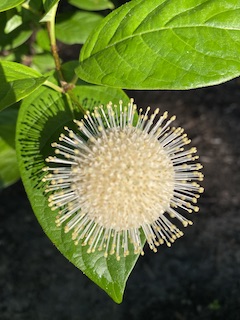
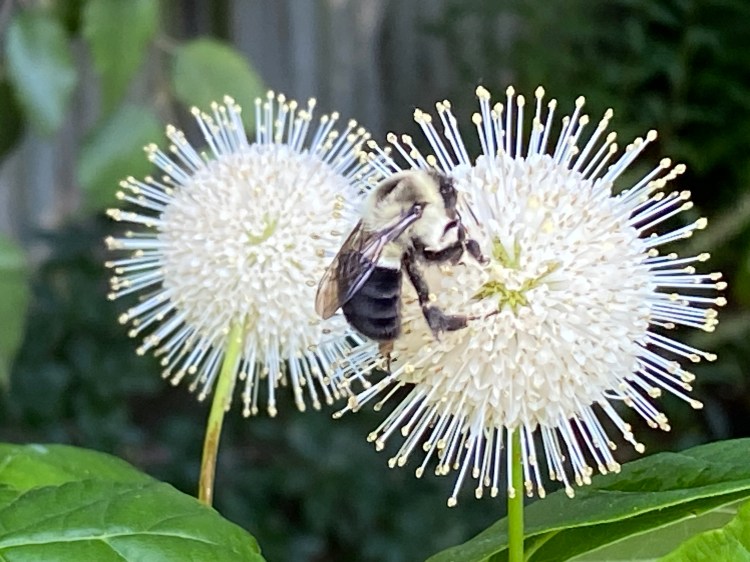
Buttonbush (Cephalanthus occidentalis) and Common Eastern Bumble Bee (Bombus impatiens)
But not any native plant from your ecoregion will do. According to some horticulturalists, the plants must be the straight species found in nature, not a cultivated variety, or cultivar, such as white echinacea or blue-leaved fothergilla. The concern is that planting native cultivars, also known as nativars, promotes genetic mixing of wild and cultivated forms of a species, with the cultivated forms eventually replacing the wild. Nativars have not developed in association with pollinators and may not be as beneficial as the straight species. To prevent genetic domination by nativars, horticulturalists may recommend planting non-native species, as long as the non-natives are not invasive.
These requirements present the gardener with challenges. If Coreopsis verticillata ‘Zagreb’ is perfect for your garden design and can be obtained from a vendor within your ecoregion, do you plant it and ignore concerns that it is a nativar and not the straight species? Or do you find another perspective to follow? According to the Mt. Cuba Center research report on coreopsis, cultivars of coreopsis provide nectar and pollen for a wide variety of insects, and ‘Zagreb’ does so for bumble bees, honey bees, the dark sweat bee, green sweat bees, and hover flies. Do these benefits outweigh the potential impact of planting a native cultivar? How does a gardener decide what to do?
Considering these issues can be a headache, and it places gardeners in the position of becoming amateur horticulturalists when they may not have the time or desire for this level of involvement. If we want more gardens, or most gardens, to be ecological gardens, we need native plant selection and acquisition to be easier processes. Many resources are available online and in print to assist (see the Xerces Pollinator-Friendly Native Plant Lists as one good example), but gardeners would benefit if more of this information was provided at the point of sale, online and at garden centers. Labeling plants as host plants, nectar plants, and pollen plants and listing the names of at least a few of the insects that depend on these plants clarifies a plant’s value, much more so than the generic term “native.” If a plant produces seeds or fruits consumed by birds, it’s useful to name the bird species the plant attracts. Adding the ecoregion to the plant label confirms the plant is appropriate for a specific location. Identifying non-native plants that provide pollinator benefits, such as pollen and nectar, with no negative environmental effects, simplifies one of the more difficult decisions of ecological gardening: is it okay to put this non-native plant in my garden?
Addressing several of these concerns is the Pollinator-Friendly Plant Labeling Act, which was introduced in the U.S. Senate on June 22, 2023. The program promoted by the Act will certify and label plants as “USDA pollinator-friendly” when certain criteria are met, including official designation as a native plant by the Chief of the USDA Natural Resources Conservation Service and production without pesticides harmful to pollinators. Certified plants will be labeled with “the county or ecoregion that the plant species is native to and locally adapted to,” the scientific and common names of the plant, and the name of the plant producer.
If the Act is signed into law, a lot of decision-making will become less complicated for experienced and aspiring gardeners. Time invested in understanding the nuances of native plant selection can be redirected to getting more plants in the ground, and perhaps to advocating for even more comprehensive labeling. The Act turns the focus away from debates about the definition of native plants and brings it back to where it should be — on helping everyone create pollinator-friendly ecological gardens that benefit the environment. And that’s a good thing.
Coombs, George. “Coreopsis: For the Mid-Atlantic Region.” Mt. Cuba Center Research Report. December 2015. Accessed September 4, 2023. https://mtcubacenter.org/trials/coreopsis/
White, Annie. “From Nursery to Nature: Evaluating Native Herbaceous Flowering Plants Versus Native Cultivars for Pollinator Habitat Restoration” (2016). Graduate College Dissertations and Theses. 626. Accessed September 4, 2023. https://scholarworks.uvm.edu/graddis/626
Last November, in my efforts to support pollinators and other insects, I left the leaves on the garden beds. In late fall and throughout winter, maple, oak, and magnolia leaves masked the bare soil of unplanted areas with a colorful, textured blanket that provided insulation and habitat. It’s now almost spring, the leaves are worn, and the blanket has turned an unremarkable brown. As the wind blows, leaves pile up against overwintering perennial stems and bury new growth pushing out from around the base of each plant.
Now the garden feels like a patch of woodland, which is great for critters, but frustrating, because I can’t see what’s going on beneath the leaves. The tiny shoots of amsonia, salvia, baptisia, and coreopsis, in all their variations, are hidden in the leaf litter. Plus it’s messy, a garden unkempt, wild. I want to clean it all up.
But when? If I remove the leaves now, how many insects like the two mourning cloak butterflies that recently danced across the garden will I destroy? I read that I need to wait for a seven-day stretch of 50-degree weather before I can clear the leaves, but I don’t know who came up with this rule. I need to do more research.
Until then, I wander in the garden, impatient, amazed when I push aside the leaves and discover more green and amused by the restraint I have to practice. Leaving the leaves is a good thing to do — I’m all in. But controlling nature by way of a tidy garden is a powerful urge.
The first kinglet of spring 2023 appeared today, in the river birch as usual. Among the branches, movements, so quick they’re easily mistaken for a trick of the wind or illusion of the eye. But look more carefully, and there it is, wings flicking as it hops from branch to branch on a relentless hunt for insects.
My guess, based on the bird’s coloring and local habitat, is that it’s a Ruby-crowned Kinglet. And if it follows the playbook from previous years, it, or others, will visit the birch again over the next few weeks.
How a three and a half-inch, two-tenths of an ounce package of feather and bone can find this tree in this yard year after year is a mystery. I’m sure there are explanations for its ability to navigate to such food sources, but knowing the process can be described only increases the magic.
The garden is beginning to move and be filled with movement. The next weeks should bring more welcome sights.
Gardening is a belief in the future. You plant, do your best to provide a good environment, cross your fingers, and hope nature will support your view of how the space should look. With living plants as the medium, the process can be tricky. Many plants will flourish in the locations you’ve chosen for them, but others will become diseased and a few may die sooner than expected.
When I look at the river birch in my garden, a heat-resistant cultivar with three beautifully exfoliating trunks, I think, everything is good. After four years, the birch has almost tripled in height and caliper, settling in to the site I selected with gusto. A success. But then I sense a problem elsewhere, something that catches my attention and is not right. The Nellie Stevens hollies that once formed a glossy dark green backdrop appear dull and covered in soot. And is it my imagination, or do the leaves on the American hornbeam look more yellow than green, a bit too chartreuse for this time of year?
What’s wrong with my plants, and just as importantly, how did I miss these problems that most likely have been developing over time?
Somewhere along the way I fell short on observation, a skill essential to gardening. It’s easy to get distracted, especially by plants that reward your efforts by thriving—my birch, for example—and grab attention from less optimal developments in the garden. But if your observational radar always is on, you have a good chance of catching problems as they develop.
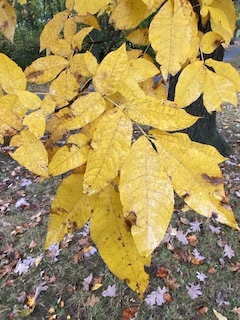
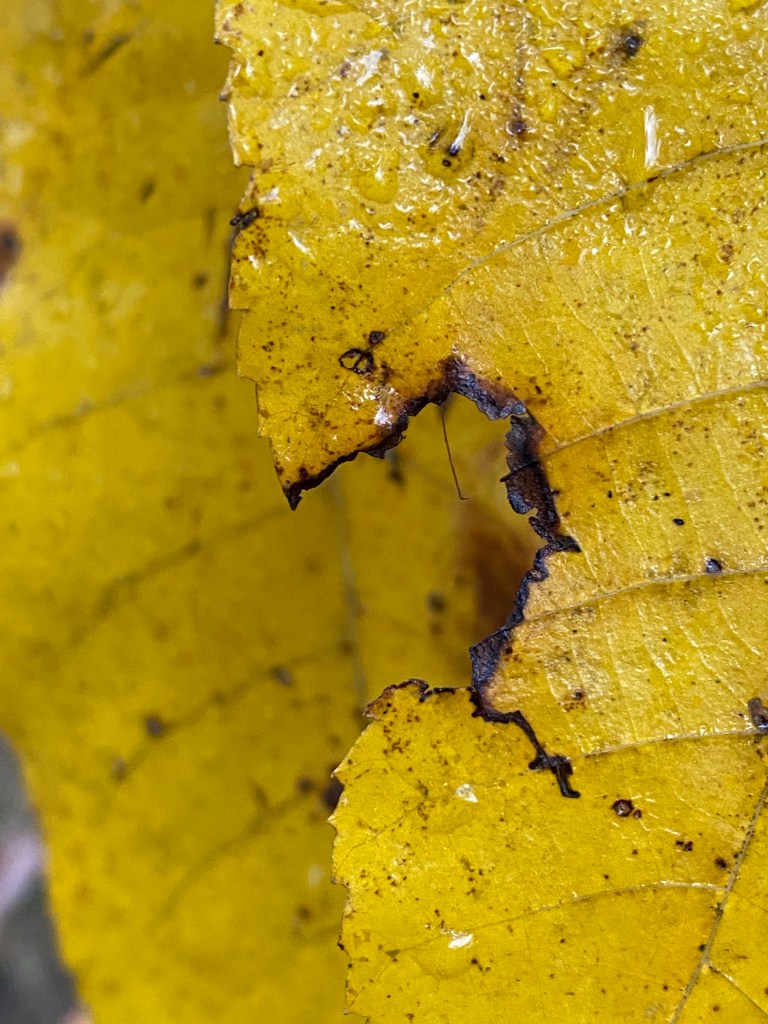
Close-up of Hickory Leaf
When you do find a problem, it’s important to slow down and analyze the situation. A plant in trouble does not necessarily require chemical treatment or removal; solutions may be more basic, especially if you’re willing to tolerate some pests and plant damage. Cutting out affected branches helped combat the cottony camellia scale that led to black sooty mold on my hollies. One year later, with improved air circulation and light, most of the leaves are a healthy, vibrant dark green. And the hornbeam’s foliage is no longer a drought-induced yellow after I established a regular and more intensive watering schedule, a reminder that recently planted trees require attention beyond their first year.
Plants are complicated organisms. You may prefer to do your own sleuthing to figure out their ailments, or you may decide you need assistance. Whichever approach you choose, a good place to start is with the research-based resources of your local university extension service. “Extension provides non-formal education and learning activities to people throughout the country — to farmers and other residents of rural communities as well as to people living in urban areas,” according to the National Institute of Food and Agriculture Extension website. Home gardeners are one of the audiences served by extension programs, with relevant resources available through services such as the University of Maryland Extension Home and Garden Information Center.
Turning to extension resources to research a problem or contacting extension experts for advice requires a bit of preparation. The more information you can provide about your plants, the easier it will be to evaluate the problem and find a solution.
Identify the plant and include the cultivated variety, or cultivar. It’s important to keep a record of what you plant, preferably as you plant. But if you’ve lost track of this information, try to recover it with a plant identification app such as iNaturalist, PictureThis, or Pl@ntNet, or use the “Look Up – Plant” function available through an iPhone camera.
Record the signs and symptoms that are causing concern. Signs indicate that pests or pathogens are present and include insect frass (droppings), insect egg masses and larvae, powdery mildew, and fungal mycelia (filaments). Symptoms are the plant’s expression that all is not well, such as stunted growth; wilting; yellowed, chewed, or dying leaves; and the development of cankers (areas of dead plant tissue) and galls (areas of swollen plant tissue). Study all parts of the plant (roots, stems, and the upper surfaces and undersides of leaves) and use a hand lens for magnified inspection.
Assess the plant’s existing cultural, or growing, conditions and determine whether they are appropriate. Does the plant receive the right amount of sunlight and water, is the soil draining properly, does the soil pH match the plant’s needs, is the hardiness zone correct, and is the plant protected from wind if it’s susceptible to winter burn or other wind-induced conditions? All of these factors affect the health of the plant. Also note whether landscape conditions have changed recently (rerouting water flow in your yard, for example, may unintentionally inundate plants or leave them too dry) and if the problem may be mechanical (an injury caused by landscape equipment) or chemical (too much fertilizer applied or herbicides drifting from another area).
Determine whether one species is affected or multiple species. If multiple species show the same symptoms, the problem may be cultural. If a single species is affected, the cause may be a plant-specific insect or pathogen.
Document the problem with photos. Be sure to capture the problem with close-ups but also to zoom out and provide context. As you photograph, imagine which visuals an extension staff member will need to diagnose the problem. Take photos of the undersides of leaves and back sides of stems, if those areas are affected, and include pictures that show the plant’s location in the garden and its cultural conditions.
Consult extension resources to research the problem or contact an extension service for assistance. This list of extension resources in the Mid-Atlantic region will help you get started.
And finally, keep observing. When you combine your observations as a home gardener with the knowledge of extension services, you improve the odds that your garden’s future is the one you want it to be.
If You’d Like to Learn More . . .
Beckerman, Janna and Tom Crewel. “Symptoms and Signs for Plant Problem Diagnosis – An Illustrated Glossary.” October 2021. Department of Botany and Plant Pathology, Purdue University. Accessed January 12, 2023. https://www.extension.purdue.edu/extmedia/BP/BP-164-W.pdf
Home & Garden Information Center. Clemson Cooperative Extension. Clemson University, South Carolina. Accessed January 13, 2023. https://hgic.clemson.edu/
Niemiera, Alex X. “Diagnosing Plant Problems.” Virginia Cooperative Extension Publication 426-714. School of Plant and Environmental Sciences, Virginia Tech. Accessed January 14, 2023. https://www.pubs.ext.vt.edu/426/426-714/426-714.html
Plant Disease and Insect Clinic. NC State Extension. Accessed January 13, 2023. https://pdic.ces.ncsu.edu/
On the day the International Union for the Conservation of Nature announced that migratory monarch butterflies had been added to the IUCN Red List of Threatened Species, I found a monarch caterpillar chewing on milkweed in my garden. The four square foot patch of butterfly weed (Asclepias tuberosa) that lured the parent butterfly to lay eggs is a scrappy transplant situated amidst a stretch of liriope. Because of the stress of digging up the milkweed’s taproot, the plant was not a particularly vigorous bloomer in its new location, which was meant as a placeholder as the garden was redesigned.
Despite these less than optimal conditions, I counted seven monarch caterpillars on the milkweed a few weeks after the IUCN announcement and, a bit later, discovered two monarch chrysalises hanging from the siding on my house. By chance, I was able to observe one monarch as it completed its metamorphosis, freeing itself from the chrysalis and drying its wings before wafting away.
An internationally recognized endangered species was reproducing in my suburban garden, on a plant temporarily stuck in the ground. Could restoring the environment really be this easy?
Well, no, but as anyone who has planted milkweed understands, such small acts can be both symbolic and practical: symbolic in that they represent potential–imagine the patch of milkweed multiplied–and practical in that they do contribute to restoration efforts, if only by a few caterpillars.
Equally important is what can be learned from this process. When you plant milkweed, the entire lifecycle of the monarch butterfly becomes visible. You realize through this experience how the destruction of monarch habitat–the removal of the milkweed host from the environment–reduces monarch populations, knowledge that makes it easier to support environmental policies favoring monarchs.
Nature provides countless opportunities to learn from small acts. A similar education occurs after planting asters, when bees and beetles, flies, moths, and butterflies land on the flowers, feeding at a time of year–late summer and autumn–when nectar and pollen are not plentiful. It becomes clear that garden design should include an element beyond aesthetics and the mantra of “right plant, right place”: right nectar, pollen, and host plants to attract and sustain pollinators and other beneficial insects year-round.
Possible Condylostylus Fly – A Mite and Aphid Predator
Watching these insects in real time leaves an impression more powerful than any articles I’ve read or webinars I’ve viewed about gardening for wildlife. “Let Nature be your teacher,” the poet William Wordsworth wrote two centuries ago, advice that is even more compelling in an era of climate change and rapid species extinction. I am awestruck as I observe these mostly tiny creatures access nectar and gather pollen, all in their own way, and marvel every time metamorphosis from egg to larva to pupa to monarch butterfly succeeds. I want to learn more. And it’s easy, once you see it, to become lost in the beauty of these creatures, the jewel-like and shimmering colors and abstract patterning of thoraxes and wings.
But it’s more than beauty that calls out for observation, it’s the behavior of individual pollinator species. The bees that visit the penstemon in spring are different from the bees that visit the agastache in summer. The tiger swallowtails that land on the verbena do not appear as interested in the nearby ruellia. How pollinators act, which plants attract them (and when those plants bloom), whether they are infrequent or frequent visitors, the time of year they arrive — these are all points of data. Such data, collected and reported by individual gardeners through citizen science projects such as Budburst and Bumble Bee Watch, and analyzed by project scientists, can help tell the story of pollinator species and how they are faring.
Planting for pollinators is a conscious act that brings beauty and life to the garden. Taking the additional step of reporting garden observations to the citizen science community lends support to conservation efforts, increasing the likelihood that pollinators, and the plants that depend on them, will survive. Nature teaches, and we watch and listen and share what we learn, giving back to keep nature going.
Lyrical Ballads, with Other Poems, 1800, Volume 1 by William Wordsworth. See the poem “The Tables Turned; An Evening Scene, on the same Subject.” Project Gutenberg. Accessed November 2, 2022. https://www.gutenberg.org/ebooks/8905
Bumble Bee Watch. The Xerces Society, the University of Ottawa, Wildlife Preservation Canada, BeeSpotter, The Natural History Museum, London, and the Montreal Insectarium. Accessed November 1, 2022. https://www.bumblebeewatch.org/